How Can a Solo Female Traveler Avoid Getting Lost at a Transit Station?
Quick Answer
A solo female traveler can avoid getting lost at a transit station by planning her route before arrival, saving the correct station entrance and platform, checking signs against her transit app, and allowing extra time for transfers. If directions become confusing, stop in a well-lit public area and ask an official station employee rather than following an unfamiliar person’s instructions. A little preparation makes navigating an unfamiliar train, metro, or bus station much less stressful.
Before You Enter the Station
- Save your route: Screenshot your destination, station names, transfer points, and final exit.
- Check the direction: Confirm the train or bus is heading toward your destination, not merely using the correct line number.
- Follow station signs: Look for platform numbers, line colors, exit numbers, and transfer symbols.
- Allow extra time: Arrive around 15–20 minutes early at an unfamiliar station, or earlier if it is a large interchange.
- Ask official staff: Use a staffed information desk, ticket counter, or clearly identified transit employee when unsure.
If You Lose Your Way
- Pause somewhere safe, check your location, and identify your next decision before moving again.
- If you feel unsafe, move toward station staff, security personnel, or a busy staffed area.
Knowing how can a solo female traveler avoid getting lost at a transit station can make exploring an unfamiliar city feel much more manageable. The key is to prepare for the journey, recognize the signs that matter, and know what to do when the route changes unexpectedly.
In this guide, I’ll explain how to plan your route, identify the right platform, manage confusing transfers, use navigation apps wisely, and protect your personal safety while finding your way around.
In This Guide
- How should you prepare before arriving at a transit station?
- How do you read station signs and find the correct platform?
- Which navigation tools help you avoid getting lost?
- What should you do when a station transfer becomes confusing?
- How can you stay safe while finding your way around?
- What should you do if you take the wrong train or exit?
- Frequently asked questions
How Should You Prepare Before Arriving at a Transit Station?

The easiest way to avoid getting lost is to make your important navigation decisions before entering a busy station. You don’t need to memorize an entire transit network; you only need to understand the next few steps of your journey.
Research the route, not just the destination
Search for your complete journey from your accommodation or current location to your intended destination. Check the starting station, line name, direction of travel, transfer station, and final stop.
A route with one transfer may be easier than a faster route involving several platforms and a complicated interchange. When you’re traveling alone in an unfamiliar city, a straightforward journey can be worth a few extra minutes.
Before leaving, write down or screenshot these details:
- Starting point: The exact station name and entrance, if available.
- Line information: The train or bus number, line color, and direction of travel.
- Transfer details: The station where you change services and the connecting line.
- Destination: Your final station, stop, or exit number.
- Backup option: Another route or a safe place where you can stop and ask for assistance.
Allow enough time to navigate calmly
For an unfamiliar station, aim to arrive 15–20 minutes before departure when practical. A major interchange, an international rail terminal, or a station with separate ticketing areas may require considerably more time.
That buffer gives you time to find a ticket machine, check departure screens, use the restroom, or ask a question without rushing. It also helps you avoid making a poor decision simply because your train is approaching.
Check the station layout before you go
Look for an official station map on the transit operator’s website. Identify the entrances, ticket gates, platforms, information desk, exits, and any connecting bus or metro services you need.
For complicated stations, save a screenshot of the map. You may not have reliable mobile data underground, and an offline reference can be useful when you cannot load a webpage.
Transit agencies such as Singapore’s Land Transport Authority explain how colors, numbers, symbols, and consistent signs help passengers navigate unfamiliar transport networks. You can explore its public transport wayfinding guidance for examples of how these systems work.
Section takeaway: Plan the route in stages, save the essential details offline, and leave enough time to ask questions before boarding.
How Do You Read Station Signs and Find the Correct Platform?
To find the correct platform, match the line name, destination direction, and platform number with your planned route. Never rely on a line color or number alone when several services share a station.
Follow signs in the right order
Large stations can contain multiple floors, separate entrances, several ticket gates, and platforms serving different directions. Trying to interpret every sign at once can make the station feel more confusing than it really is.
Instead, follow the signs one decision at a time:
- Find the line: Look for your metro, subway, railway, or bus service.
- Confirm the direction: Check the destination displayed for your platform or service.
- Locate the platform: Follow the numbered signs or arrows to the correct boarding area.
- Verify the departure: Compare the destination and departure information on the electronic display.
- Check again before boarding: Make sure the arriving service matches your intended direction.
This approach is useful because station entrances and platforms do not always follow the same layout. A platform on the opposite side of a station may serve the return direction, even when both platforms carry the same line color.
Understand line colors, numbers, and destination names
Many transit systems use a combination of colors, letters, numbers, arrows, and station names. Learn the symbols used on your particular network instead of assuming every city follows the same rules.
For example, a hypothetical journey might involve the Blue Line toward Central Station, followed by a transfer to the Green Line toward Riverside. The color identifies the service, but the direction and destination confirm which train you need.
Pay particular attention to signs that say:
- Exit: The route out of the station, sometimes identified by a letter or number.
- Transfer or interchange: A connection to another line or transportation service.
- Outbound or inbound: A direction label whose meaning depends on the transit network.
- Terminus: The final station on a particular service.
- Replacement service: Alternative buses or routes operating during a disruption.
Use the station name as your reference point
At large stations, you may encounter several signs pointing in different directions. Rather than memorizing every turn, keep checking the next station name or transfer point against your saved route.
If the sign doesn’t match your route, stop before entering a platform or passing through another set of gates. A short pause is easier to manage than discovering the mistake after boarding.
Official guidance from the National Association of City Transportation Officials explains how clear route maps, directional signs, and passenger information support transit navigation. Its principles are useful when deciding which station information to look for first.
Section takeaway: Match the line, direction, platform, and destination before boarding. If one detail conflicts with your route, verify it rather than guessing.
Which Navigation Tools Help You Avoid Getting Lost?
A transit app, an offline map, and a saved route screenshot provide a practical navigation system for solo travel. Each tool serves a different purpose, so keep a backup rather than depending entirely on your phone’s live connection.
Use a transit app for current routes
Choose an app that supports the public transportation network in your destination. Depending on the city, it may show departure times, service disruptions, platform information, transfers, and walking directions between stations.
Google Maps and local transit-authority apps can be helpful starting points, but coverage and features vary. Confirm important departure details against official station displays or the operator’s current service announcements.
Before traveling, check whether your app provides:
- Station-to-station directions and transfer instructions.
- Current service alerts or schedule changes.
- Walking directions to station entrances and exits.
- Offline map access or saved places.
- Alternative routes when a service is delayed or suspended.
Prepare for weak internet or a dying battery
Underground stations, crowded terminals, and unfamiliar neighborhoods can make live navigation inconvenient. Download an available offline map, save the destination address, and take screenshots before leaving reliable Wi-Fi.
Keep your phone sufficiently charged for the journey. If you expect a long day of sightseeing, a charged power bank can help you preserve navigation and emergency communication.
Remember that an offline map may not contain live train schedules or current platform changes. Use it to orient yourself, then check official signs for time-sensitive information.
Use a simple navigation checklist
When you arrive at each station, confirm three things: where you are, where you need to go next, and how you will know you’ve reached the right place.
| Navigation tool | Best use | Main limitation |
|---|---|---|
| Transit app | Routes, transfers, and service updates | May need internet or may lack live data |
| Offline map | Finding your location without mobile data | May not show live service changes |
| Route screenshots | Quick reference for station names and transfers | Can become outdated after disruptions |
| Official station map | Finding platforms, exits, and facilities | May be difficult to interpret at first |
| Station employee | Resolving conflicting directions or disruptions | Availability and languages vary |
No single tool is perfect. Cross-checking two reliable sources, such as your saved route and an official departure display, is often enough to catch a mistake before it becomes a missed connection.
Section takeaway: Use digital navigation for planning, official signs for immediate decisions, and a saved offline reference as your backup.
What Should You Do When a Station Transfer Becomes Confusing?
If you cannot find your connecting platform, pause in a safe public area and identify the next step before moving. Transfers are easier to manage when you focus on one connection instead of trying to reconstruct your entire journey.
Find the transfer signs first
At an interchange, follow signs for your connecting line rather than immediately heading toward the main exit. Leaving the station can require another ticket, another fare, or a walk through unfamiliar streets.
Check whether your transfer requires a platform change, a different station entrance, or a short outdoor walk. Some interchange stations use similar names for separate buildings, so verify the exact location before following walking directions.
Ask for help with a specific question
If the signs remain unclear, approach a ticket counter, information desk, station employee, or security worker. Show your destination and ask which direction or platform you need.
Short questions are often easier to understand than a long explanation. You can use these phrases:
- “Which platform goes to Central Station?”
- “Is this the train toward Riverside?”
- “Where do I change for Line 2?”
- “Do I need to exit the station to transfer?”
- “Can you show me the direction on this map?”
If you don’t speak the local language, display the station name in its local spelling. A translation app can help, but a written destination or map can communicate your question even when conversation is difficult.
Know when to take the next service
You don’t have to catch the first train you see. If you’re uncertain about the direction, wait until you’ve confirmed the service, even if that means taking the next departure.
For scheduled rail journeys, check whether missing the departure affects your ticket. Some tickets allow later services, while others require a change or rebooking under the operator’s rules.
For a delayed connection, check the official service notice before choosing an unfamiliar alternative route. A replacement bus or a different platform may be correct, but you should confirm the information first.
When a transfer feels overwhelming, reduce the decision to one question: “What is the next confirmed step toward my destination?” Then take that step and check again.
Section takeaway: Follow transfer signs, verify the next service, and ask a specific question when necessary. Missing one departure is better than boarding the wrong train.
How Can You Stay Safe While Finding Your Way Around?
Good navigation and personal safety work together when you’re traveling alone. Choose routes that are easy to understand, keep your belongings secure, and seek help from identifiable staff when something feels wrong.
Choose visible, well-used routes through the station
When several routes lead to a platform or exit, look for clearly marked, well-lit public passageways. Avoid unnecessary detours through isolated corridors, empty parking areas, or unfamiliar station exits, particularly late at night.
A busy station isn’t automatically safe, and a quiet area isn’t always dangerous. Still, staying near staffed facilities and other passengers gives you more options if you need directions or assistance.
Keep your phone and belongings secure
It’s tempting to walk through a station while staring at a map. Instead, step aside in a suitable public area to check directions, then put your phone away while moving through crowds or boarding.
These habits can make navigation easier and help protect your belongings:
- Keep your bag zipped and valuables secure, especially near ticket gates and crowded escalators.
- Carry your phone in a secure pocket or bag when you’re not actively using it.
- Stay aware of your surroundings rather than wearing headphones at a volume that blocks announcements.
- Keep your ticket, payment method, and identification accessible without displaying everything at once.
- Tell a trusted person your general itinerary when traveling through an unfamiliar area late in the day.
Know whom to approach for assistance
Official employees, information-desk staff, and station security personnel are useful starting points when you feel lost. Look for uniforms, identification badges, and clearly marked service counters.
If someone approaches you with unsolicited help, you can politely decline and verify their directions independently. You don’t need to accept a ride, leave the station with a stranger, or hand over your phone to receive assistance.
If you believe someone is following you or making you feel unsafe, move toward a staffed public area and explain your concern directly. Seek station security or local emergency services if the situation becomes threatening.
For additional general advice, the U.S. Department of State’s guidance for women travelers covers planning and personal safety considerations for international trips. Travelers of other nationalities can also consult their own government’s travel advice.
Pro tip: Before your trip, check current official travel advice and save the local emergency number. Emergency procedures and station security arrangements vary by destination.
Section takeaway: Navigate from visible public areas, keep your belongings secure, and seek assistance from identifiable staff instead of relying on unsolicited help.
What Should You Do If You Take the Wrong Train or Exit?
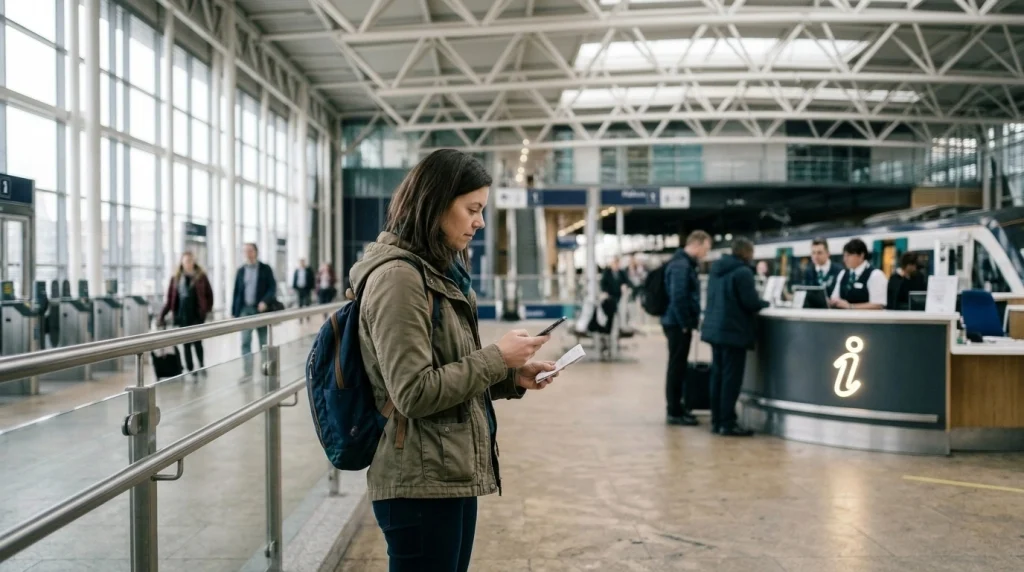
Taking the wrong train or leaving through the wrong exit is a navigation mistake, not a travel disaster. The safest response is to pause, establish your current location, and choose a verified route back toward your destination.
If you board the wrong train
Check the next station and compare it with your saved route. If you confirm that you’re traveling in the wrong direction, get off at a suitable station and check the return platform or another valid route.
Don’t jump off a moving train, force doors open, or rush across tracks to correct a mistake. Follow normal passenger procedures and use official signs to find the correct service.
If you leave through the wrong exit
First, identify the exit number or street name shown on your map. Compare nearby street signs, landmarks, and the station entrance with your saved destination.
If you’re still inside the station, follow the official signs back toward the appropriate exit when permitted. If you’ve already left, use a mapped walking route or return to a staffed entrance to ask for directions.
A wrong exit can put you on the opposite side of a large road or several blocks away from your intended destination. Don’t assume you can cross directly; use designated pedestrian crossings and marked routes.
If your phone stops working
Use your screenshots, written station names, and any available printed station map. If you have no usable navigation information, approach an official employee or information counter.
For a long journey, it’s sensible to keep your destination address written down separately from your phone. This is especially helpful when traveling somewhere with unreliable mobile coverage or a language barrier.
Use a simple recovery plan
- Stop: Move to a safe place away from boarding flows, stairs, and platform edges.
- Identify: Check the station name, exit, platform, or next-stop display.
- Compare: Match your current location with your saved route.
- Verify: Check official signs or ask station staff for the correct next step.
- Continue: Take the confirmed route, allowing extra time if necessary.
Transit safety advice from the Pennsylvania Department of Transportation also recommends planning ahead, allowing sufficient time, and following public transportation instructions. Although local systems differ, these habits are useful for first-time riders in many destinations.
Section takeaway: Don’t panic or rush to correct a mistake. Confirm where you are, ask for help when needed, and follow the safest verified route.
Frequently Asked Questions
1. How early should a solo female traveler arrive at an unfamiliar transit station?
Arriving 15–20 minutes early is a useful starting point for an unfamiliar station. Allow more time for major interchanges, international rail terminals, ticket purchases, accessibility needs, or complicated transfers. Check the operator’s departure requirements before traveling.
2. What should I do if I cannot understand station signs?
Use your saved route, line colors, platform numbers, and destination names to identify the next step. Display the station name in the local language and use a translation app if needed. If you’re still unsure, ask an identifiable station employee or visit an information desk.
3. Can I rely entirely on Google Maps to navigate a transit station?
No. Google Maps can help plan routes and transfers, but its coverage and real-time information vary by location. Confirm platform numbers, service changes, and departure directions using official station displays or the local transit operator’s app.
4. Is it safer to ask another passenger for directions?
Another passenger may offer useful directions, but official station staff are generally the better first choice when you need to confirm a platform or resolve conflicting information. If you ask a passenger, verify the answer against station signs before boarding.
5. What if I miss my train because I cannot find the platform?
Check the next departure and confirm whether your ticket permits travel on a later service. If you need to change your booking, ask the operator’s staff about your options. Avoid boarding an unverified train simply because you’re worried about losing time.
6. How can I navigate a station when my phone battery dies?
Use printed station maps, written destination names, and any screenshots or offline information you prepared earlier. Ask official staff for help if necessary. For future journeys, charge your phone before leaving and consider carrying a charged power bank.
7. What is the best way to avoid getting lost during a station transfer?
Before leaving your first train, confirm the connecting line and station name. Follow transfer signs instead of exit signs, check the direction of travel, and verify the connecting service on an official display. Leave extra time when the interchange is unfamiliar.
Make Your Next Transit Journey Easier
Learning how a solo female traveler can avoid getting lost at a transit station starts with a few repeatable habits: plan the route, save important details, follow signs in sequence, and confirm the direction before boarding.
You don’t need to know every station in a city to navigate it confidently. You only need to identify your current location and make the next decision carefully.
Before your next solo trip, choose one transit journey and review it from start to finish. Save the route, note the transfer and exit, and identify where you’ll ask for help if the signs are unclear.
Most importantly, give yourself permission to pause. Missing a departure or asking for directions is a normal part of learning an unfamiliar transit system, and neither is a reason to compromise your safety.