How Can a Woman Evaluate an Airbnb Location for Safety?
Quick Answer
A woman can evaluate an Airbnb location for safety by researching the surrounding neighborhood, checking recent guest reviews, assessing transportation and nighttime access, verifying entry security, and asking the host specific questions before booking. No listing, rating, or neighborhood description guarantees personal safety, so compare several sources and choose accommodation that fits your itinerary and comfort level.
What to check before booking
- Neighborhood conditions: Research recent local safety information, street lighting, nearby services, and the route between attractions and your accommodation.
- Guest reviews: Look for repeated comments about uncomfortable encounters, difficult access, poor lighting, or problems returning at night.
- Transportation: Check walking distances, public transit availability, and reliable late-night transport options.
- Property security: Confirm that the entrance locks, windows are secure, and the listing accurately describes private or shared spaces.
- Host communication: Ask about check-in, access arrangements, shared areas, and how to get help if something goes wrong.
- Backup options: Review cancellation terms, save emergency contacts, and identify alternative accommodation before arrival.
One important precaution
- Verify independently: Use the official lodging safety guidance alongside current local information instead of relying on photographs or a host’s assurances alone.
Choosing an Airbnb is about more than finding an attractive apartment at a good price. For women traveling alone, the surrounding streets, arrival arrangements, and ability to return comfortably after dark can matter just as much as the accommodation itself.
I approach accommodation research as a practical risk assessment rather than a search for a supposedly perfect neighborhood. The goal is to identify warning signs, verify important details, and choose a location that supports the trip I actually plan to take.
This guide explains how to evaluate an Airbnb location for safety in 2026, from researching the neighborhood to checking entry arrangements and preparing a backup plan.
In This Guide
- What makes an Airbnb location safe for a woman traveling alone?
- How do you research the neighborhood before booking?
- How can you use Airbnb reviews to spot safety concerns?
- How do you assess transportation and nighttime access?
- What property security features and host questions matter?
- How should you compare Airbnb locations before booking?
- What should you do before and after arrival?
- Frequently asked questions
What Makes an Airbnb Location Safe for a Woman Traveling Alone?
A safe-feeling Airbnb location combines a suitable neighborhood, secure access, dependable transportation, clear host communication, and convenient access to help. No single feature proves that a property or its surroundings are safe.
Location safety means assessing both the immediate property and the environment around it. A well-maintained apartment may still be inconvenient if the entrance sits down an isolated alley or the nearest reliable transport stops running before your evening plans end.
Evaluate the complete arrival-to-departure experience
Start by imagining your actual travel routine, including the moments when you might feel most vulnerable. These often include arriving with luggage, finding an unfamiliar entrance, returning after dinner, or leaving early for a train.
- Street environment: Check lighting, visibility, pedestrian access, and whether the route includes isolated passages.
- Building access: Determine whether the entrance has a functioning lock and whether strangers can enter shared areas easily.
- Daily convenience: Identify nearby shops, transport stops, restaurants, and other services you expect to use.
- Emergency access: Find out how to contact local emergency services and reach a hospital if necessary.
- Personal comfort: Consider whether you would feel comfortable arriving or returning alone at your expected times.
These checks are more useful than relying on a broad label such as “safe neighborhood.” Conditions can change between streets, buildings, and times of day.
Separate neighborhood safety from property safety
Neighborhood safety concerns the surrounding streets, local conditions, transport routes, and access to services. Property safety concerns the building entrance, locks, privacy, fire precautions, and the people who can access the accommodation.
Evaluate both independently. A convenient central location does not automatically mean secure entry, and a secure apartment does not eliminate risks associated with isolated streets.
How Do You Research the Neighborhood Before Booking?
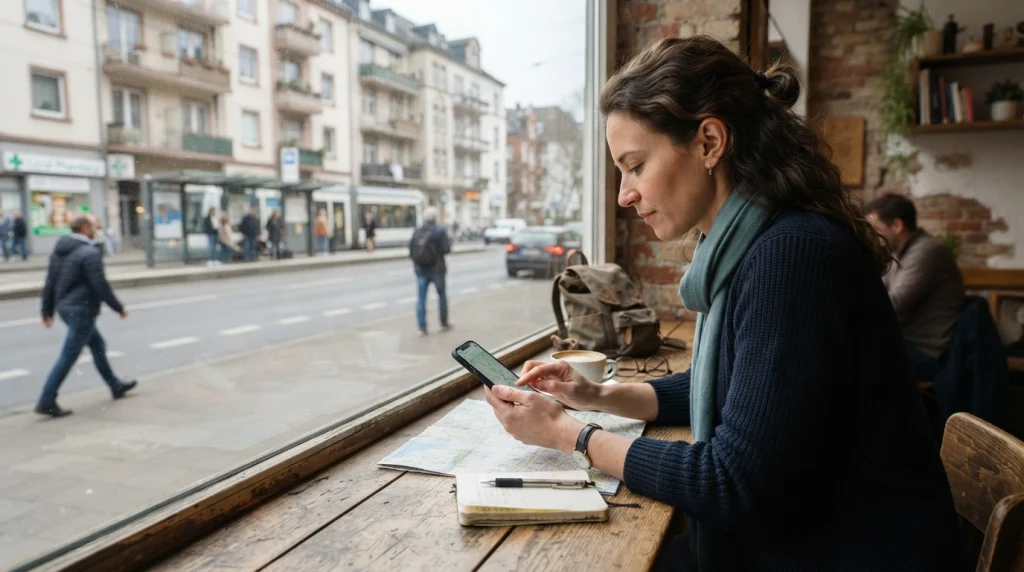
Research an Airbnb neighborhood using maps, recent guest feedback, local information, and official travel guidance. Compare these sources instead of assuming that attractive listing photos or a host’s description accurately represent the surrounding area.
Use maps to examine the immediate surroundings
Open a mapping service and inspect the streets around the approximate listing location. Look beyond the distance to major attractions and examine the routes you would use most frequently.
- Check the walking route from the nearest public transportation stop.
- Look for grocery stores, restaurants, pharmacies, and other useful services.
- Inspect the street layout for isolated lanes, poorly connected roads, or routes without obvious alternatives.
- Use available street-level imagery to examine entrances and the surrounding environment, remembering that images may be old.
- Estimate travel times for the hours you expect to arrive and return.
Airbnb may show an approximate location before booking rather than the exact property address. Ask the host for additional location details that can help you assess access without requesting information they are not permitted to disclose.
Check local safety information and travel advisories
Look for recent, location-specific information about crime, demonstrations, transport disruptions, and other conditions that could affect your stay. Official travel advisories can help identify broader risks, although they rarely provide a complete assessment of an individual street.
For international trips, consult the U.S. Department of State travel advisories and the relevant destination’s official government guidance. Travelers of other nationalities should also consult their own government’s travel advice.
For a more local perspective, check municipal safety resources, public transport announcements, and recent reports from reputable local news organizations. Avoid treating a single social media post as proof that an entire neighborhood is dangerous.
Look for useful local perspectives
Recent accounts from women who have visited the area can reveal practical concerns that general travel guides overlook. Search for comments about late-night walking, access to transport, harassment, and whether the area feels different after businesses close.
Compare several independent perspectives and pay attention to when the information was published. A neighborhood can change, and one person’s comfort level may differ from yours.
Pro tip: Review official travel advice before departure, then verify neighborhood conditions close to your arrival date. Broad safety guidance cannot replace current local information.
How Can You Use Airbnb Reviews to Spot Safety Concerns?
Read recent Airbnb reviews for specific details about the location, entrance, check-in process, host communication, and guests’ experiences returning to the property. Repeated, concrete concerns deserve more attention than a single vague complaint or a high overall rating.
Search for details rather than star ratings alone
A highly rated property can still be unsuitable for your needs. Some guests prioritize price, decor, or proximity to attractions, while you may place greater importance on arriving independently and feeling comfortable outside after dark.
Read the most recent reviews first, then compare them with older feedback to identify recurring patterns. Look for descriptions of the actual stay rather than assuming every positive or negative comment tells the complete story.
- Location concerns: Guests mention isolated streets, difficult-to-find entrances, or uncomfortable walks from transport.
- Access problems: Reviewers describe unreliable key codes, broken locks, or confusing check-in arrangements.
- Privacy issues: Guests report unexpected access to their rooms or unclear boundaries in shared accommodation.
- Communication problems: Several reviewers struggle to reach the host when important issues arise.
- Repeated discrepancies: Guests describe material differences between the listing and the property they received.
Airbnb explains its approach to choosing a place and reading guest reviews. Reviews can help you make an informed decision, but they cannot guarantee future conditions.
Know which review patterns deserve attention
One complaint about street noise might reflect personal preference rather than a safety problem. Several recent accounts describing poor lighting, unreliable access, or uncomfortable late-night routes provide a stronger reason to investigate further.
Likewise, a new listing with few reviews is not automatically unsafe. It simply offers less public feedback, so you may want clearer host answers, more independent location research, or a property with a longer track record.
Don’t ignore a concern just because other reviewers gave the property excellent ratings. If a detail matters to your personal safety, ask the host to clarify it before committing.
How Do You Assess Transportation and Nighttime Access?
Evaluate how you will reach the Airbnb from the airport, station, or bus terminal and how you will return after your planned activities. A location that works during daylight may become inconvenient when public transportation becomes less frequent or nearby businesses close.
Test the routes you are likely to use
Check the journey for your expected arrival time, not just a convenient midday departure. Consider how much walking you must do with luggage and whether a reliable alternative exists if your first transport option is unavailable.
- Public transportation: Confirm operating hours, the nearest stops, and the distance from the stop to the property.
- Airport transfers: Identify reputable taxi services, licensed ride-hailing options where available, or official airport transport.
- Nighttime returns: Check whether you can reach the property without depending on a long, isolated walk.
- Mobile connectivity: Confirm that you can access maps, booking details, and transport apps when needed.
- Backup routes: Identify an alternative way to reach your accommodation if a service is disrupted.
Convenience matters because complicated journeys can leave you stranded or force you to make rushed decisions when tired. Paying somewhat more for dependable transport may be worthwhile if it reduces those difficulties.
Compare the neighborhood at different times
Street-level imagery, local business hours, and transport schedules can help you understand how an area functions throughout the day. However, these sources cannot reliably establish how safe a particular street will feel on the night you visit.
Ask the host whether the entrance is easy to identify after dark and whether the building has outdoor lighting. If you plan to arrive late, confirm that self-check-in instructions will work without someone needing to meet you in person.
Never assume a short distance means an easy walk. A route of 500 meters along well-lit, busy streets may suit you better than a shorter route through an isolated passage.
What Property Security Features and Host Questions Matter?
Check whether the Airbnb provides secure entry, adequate privacy, clear access arrangements, and appropriate basic safety information. Ask the host direct questions before booking whenever the listing leaves an important detail unclear.
Check the entrance and privacy arrangements
Review the listing photos and description for the actual access route, door arrangements, windows, and whether other people share the property. If the accommodation is a private room rather than an entire home, establish who else lives there and which spaces are shared.
- Is the entrance door fitted with a working lock?
- Can you secure your private bedroom independently, where applicable?
- Are windows and accessible exterior doors lockable?
- Does the building have a controlled entrance, where appropriate?
- Are any shared areas or access arrangements different from what the listing describes?
- Are smoke alarms, fire safety equipment, and emergency instructions provided as applicable?
Airbnb’s home safety requirements describe host responsibilities concerning safety hazards and their disclosure. A platform policy is useful guidance, but it does not mean every listing has been physically inspected or that every potential risk has been identified.
Send the host specific questions
Clear questions help you evaluate the listing and the host’s willingness to communicate. Keep important conversations within Airbnb’s messaging system so you have a record of the information provided.
You can adapt this message before booking:
Hello, I’m considering booking your property for a solo trip. Could you clarify how secure the main entrance is, whether the accommodation has a private lock, and how late check-in works? I’d also appreciate details about the route from the nearest transport stop and any shared spaces or access arrangements I should know about. Thank you.
Assess the substance of the response rather than expecting a particular tone. A useful reply answers your questions clearly and consistently with the listing.
Be cautious if the host pressures you to book immediately, avoids basic access questions, or asks you to pay outside Airbnb. These behaviors do not independently prove a safety threat, but they justify further scrutiny or choosing another property.
How Should You Compare Airbnb Locations Before Booking?
Compare properties against the same safety and convenience criteria instead of choosing solely by price or appearance. A simple checklist makes trade-offs visible and helps you identify unanswered questions before making a reservation.
The table below is a practical decision framework, not a statistical safety rating. It illustrates how two hypothetical properties might compare; it does not describe actual Airbnb listings.
| Evaluation factor | Property A: Central | Property B: Outlying |
|---|---|---|
| Transport | Short walk to a verified transit stop | Longer walk; fewer late services |
| Nighttime access | Main streets and multiple route options | Route requires further investigation |
| Entry security | Locking arrangements confirmed | Locking arrangements unclear |
| Guest feedback | Recent reviews describe access clearly | Few reviews; limited evidence |
| Overall decision | More information is available to assess | Verify outstanding details before booking |
Property A appears easier to assess from the information shown, but its central location does not prove that it is safer. Property B could be perfectly suitable if further research confirms dependable transport, secure access, and acceptable surroundings.
Use a consistent pre-booking scorecard
For each shortlisted listing, record whether the following checks are confirmed, uncertain, or concerning.
- Location: Recent local information and neighborhood context reviewed.
- Transport: Arrival and nighttime routes checked.
- Reviews: Recent feedback read for recurring access or safety concerns.
- Security: Essential locks and privacy arrangements confirmed.
- Communication: The host answered important questions clearly.
- Contingency: Cancellation conditions and backup accommodation considered.
Don’t let a high total compensate for a serious unresolved concern. If you cannot establish whether the entrance is secure or how you will access the property at night, pause the booking and seek clarification.
The best option is the property that meets your essential requirements with the fewest unresolved concerns, within a budget you can comfortably afford.
What Should You Do Before and After Arrival?
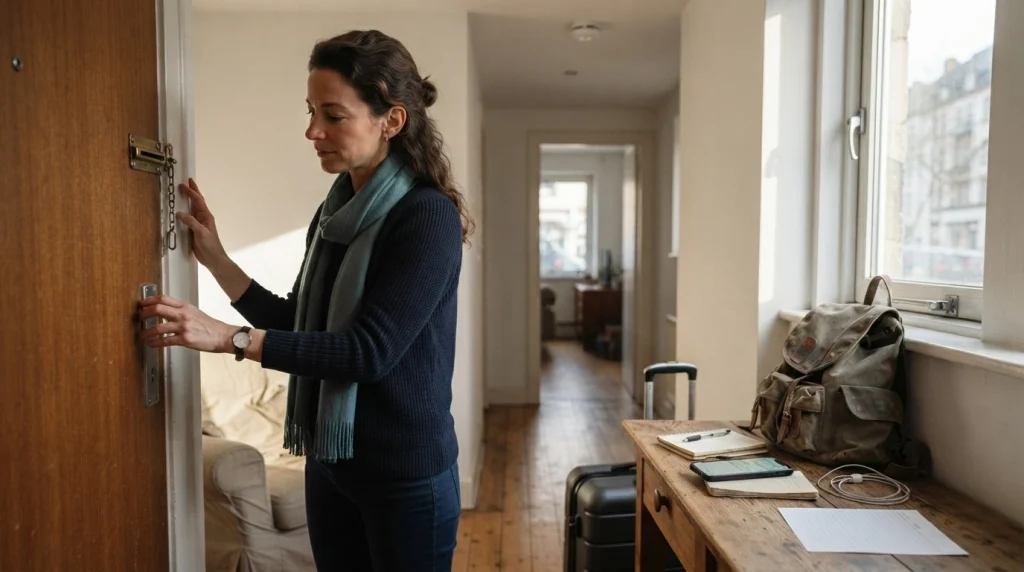
Complete a final review before traveling, then verify the property and its access arrangements when you arrive. Preparation reduces avoidable uncertainty, but you should remain willing to change plans if the actual conditions differ materially from what you expected.
Before you book and travel
- Save the listing details, address when available, host messages, and check-in instructions.
- Read the cancellation policy and understand the available support options.
- Share your accommodation details and arrival plan with a trusted person.
- Save local emergency numbers and identify nearby medical services.
- Keep enough money and payment access for an alternative journey or stay.
- Confirm the check-in time, entrance instructions, and host contact method.
- Check official travel guidance again shortly before departure.
For international travel, the UK government’s guidance on solo and independent travel also recommends researching accommodation, considering security, and planning ahead.
When you arrive at the Airbnb
Inspect the entrance and immediate surroundings before settling in. Confirm that the property matches the listing and that the locks, privacy arrangements, and essential safety features work as expected.
- Check that doors and accessible windows close and lock properly.
- Locate smoke alarms, fire extinguishers where provided, and emergency exit routes.
- Confirm that the host’s check-in instructions match the actual property.
- Keep your phone charged and store emergency contacts where you can access them.
- Let your trusted contact know that you have arrived.
If the property differs significantly from the listing or you encounter a serious security concern, document the issue and contact Airbnb through its official support channels. If you face immediate danger, move to a safer public location if possible and contact local emergency services.
Airbnb provides information about its home safety requirements and support options. Keep the platform’s current policies available when deciding how to report a problem or request assistance.
Trust your judgment. You do not need to prove that a place is objectively dangerous before deciding that it does not meet your personal safety needs.
Frequently Asked Questions
Is Airbnb safe for women traveling alone?
An Airbnb can be a suitable choice for a woman traveling alone, but safety varies by property, neighborhood, and individual circumstances. Review the location, guest feedback, entry security, host communication, and transport options before booking, and prepare a backup plan.
How can I tell whether an Airbnb neighborhood is safe at night?
Check recent local information, street lighting, transport schedules, guest comments, and the walking route from nearby stops. No online map or neighborhood label guarantees nighttime safety, so consider alternative transport and whether the route fits your comfort level.
Should I book an Airbnb with no reviews?
A listing without reviews is not automatically unsafe, but it offers less evidence about previous guests’ experiences. Research the surrounding area independently, ask the host specific questions, and consider a better-established alternative if important safety details remain unclear.
Is a private room or an entire Airbnb better for solo female travelers?
Neither option is automatically safer. An entire property may provide more privacy, while a private room in an occupied home may offer access to a host or other residents. Compare locks, shared access, house rules, privacy, and your personal comfort before choosing.
What should I do if my Airbnb feels unsafe after check-in?
If you feel unsafe, prioritize getting to a safer place rather than staying to investigate. Contact local emergency services if you face immediate danger, notify Airbnb through official channels, document relevant problems when safe, and arrange alternative accommodation if needed.
Can an Airbnb’s verified location badge guarantee safety?
No. Airbnb explains that location verification has limitations and does not establish that a property or surrounding neighborhood is safe. Continue checking guest reviews, the actual location, access arrangements, and relevant local information even when a listing displays a verification badge.
What is the most important safety check before booking?
Start with the complete arrival and return journey, then confirm secure property access. A convenient location, dependable transport, clear check-in instructions, and working locks can help reduce avoidable problems, but no single check replaces a broader assessment.
Final Takeaway: Choose an Airbnb That Fits Your Safety Needs
Learning how to evaluate an Airbnb location for safety gives you a clearer basis for making booking decisions. Look beyond the photos and nightly rate to investigate the surrounding streets, transport routes, recent reviews, entrance security, and host communication.
Before confirming your reservation, resolve important uncertainties and keep a realistic alternative available. A well-researched accommodation choice cannot remove every travel risk, but it can help you make a more informed decision and travel with greater confidence.
Pro tip: Recheck official travel advisories and local transport information before departure, particularly when traveling internationally or arriving late at night.
Affiliate disclosure: This article is informational and does not guarantee the safety of any accommodation or neighborhood. Always verify current conditions and review the booking platform’s applicable policies before making a reservation.