How Can a Woman Plan a Solo Trip Around Public Transportation?
Quick Answer
A woman can plan a solo trip around public transportation by choosing a well-connected destination, staying near a useful transit station, checking airport-to-hotel routes, and building each day around realistic train, metro, tram, or bus connections. I also recommend checking current travel guidance for women before an international trip.
Plan Your Transit-Based Solo Trip
- Choose a connected destination: Look for frequent public transportation and several ways to reach major areas.
- Map your arrival: Know exactly how you will travel from the airport or station to your accommodation.
- Stay near transit: Pick accommodation within an easy walk of a station or useful bus route.
- Check operating hours: Research first and last services before planning early departures or late evenings.
- Keep a backup: Identify an alternative train, bus, licensed taxi, or reputable ride service.
- Save details offline: Keep routes, addresses, tickets, and maps available without mobile data.
Planning a solo trip around public transportation can make traveling alone simpler, cheaper, and more flexible. I often find that understanding the transport network first makes the rest of my itinerary fall into place.
The key is not just choosing a city with buses or trains. You need routes that work for your accommodation, arrival time, daily plans, luggage, and personal comfort.
In This Guide
- What Makes a Destination Good for a Public-Transportation Solo Trip?
- How Should You Choose Accommodation Around Public Transportation?
- How Do You Build a Solo Itinerary Around Transit?
- How Can a Woman Use Public Transportation More Safely Alone?
- What Tickets, Apps, and Backup Plans Should You Prepare?
- How Can You Test Your Transit Plan Before Booking?
- Frequently Asked Questions
What Makes a Destination Good for a Public-Transportation Solo Trip?
A good destination lets you complete most important journeys without depending on one difficult connection. Frequent services, clear stations, central accommodation, and backup options matter more than simply having a metro map.
Public-transportation-based solo travel means planning a trip where trains, metros, trams, buses, ferries, and walking replace most private car journeys.
Look at frequency before coverage
A transport map can look impressive while service is surprisingly limited. I always check how often the routes I would use actually run.
- Frequent routes: Regular services give you flexibility when plans change.
- Simple transfers: Direct journeys reduce stress when you’re carrying luggage.
- Useful operating hours: Check whether service continues after dinner or evening activities.
- Central stations: Stations near hotels, restaurants, and attractions reduce extra transfers.
- Backup routes: Ideally, one missed bus should not ruin your entire day.
For planning between cities, I sometimes use Rome2Rio as an early research tool. I still confirm final schedules and ticket rules with the actual transit operator.
Think door to door
Never judge a route only by the main train or metro ride. Look at the full journey from your accommodation door to the attraction, airport, or next hotel.
A 25-minute train ride may require a 20-minute walk, two staircases, and another bus. That can feel quite different when you’re alone with luggage.
| Transport Factor | Easier Setup | More Planning Needed |
|---|---|---|
| Frequency | Service every 5–20 minutes | Only a few departures daily |
| Transfers | Direct or one simple transfer | Several transfers or station changes |
| Accommodation | 5–10 minute walk from transit | Long walk or feeder bus required |
| Evening travel | Regular late service | Early final departure |
| Backup option | Another route or licensed taxi | One route with no easy alternative |
Section Takeaway: Choose a destination where public transportation gives you options, not just coverage. Frequency, simple transfers, and backup routes make solo travel much easier.
How Should You Choose Accommodation Around Public Transportation?
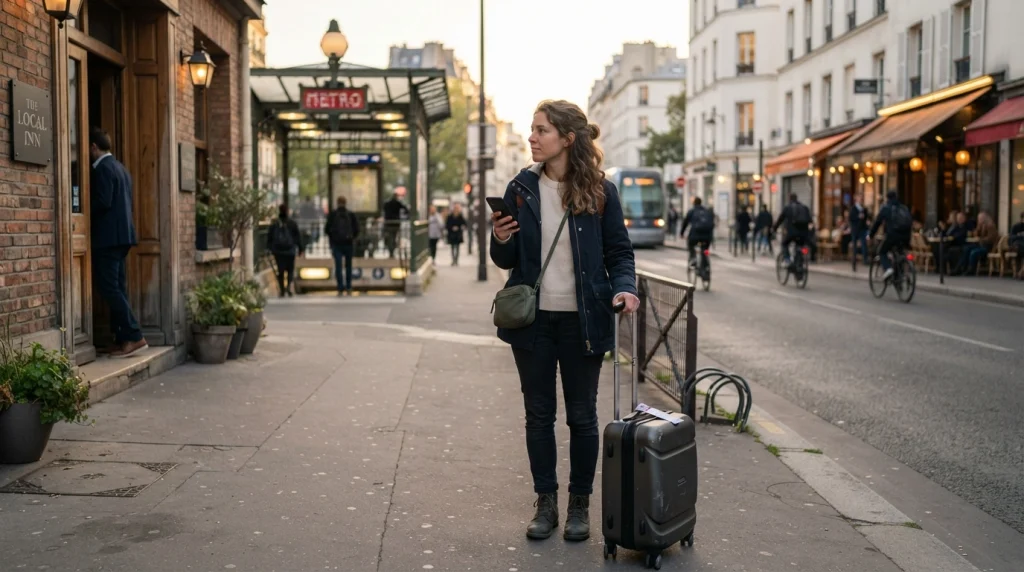
Choose your accommodation after studying the transport network, not before. A slightly more expensive room near a useful station can simplify almost every day of the trip.
Map the routes you will actually use
I normally shortlist hotels or hostels only after marking several likely journeys. This quickly shows whether a cheap room is genuinely convenient.
- Airport or railway station to accommodation
- Accommodation to the main sightseeing area
- Accommodation to restaurants or cafés
- Accommodation to one evening activity
- Accommodation to your departure point
- Accommodation to a pharmacy or convenience store
Look beyond straight-line distance. A property 600 meters from a station may involve steep streets, poorly surfaced paths, or several flights of stairs.
Pay attention to station exits
Large stations can have several exits spread across different streets. The wrong exit can turn a short walk into an unnecessary detour.
Before arriving, I save the name or number of the exit nearest my accommodation. It is a tiny detail that helps when I’m tired.
Think about the return journey
A neighborhood can feel wonderfully convenient at noon and awkward late in the evening. Check the transport schedule for the hours you expect to return.
- When does regular service slow down?
- What time is the final train, tram, or bus?
- Is the walk from the stop straightforward?
- Are licensed taxis or reputable ride services available?
- Does your accommodation have late check-in arrangements?
Section Takeaway: The best transit-friendly accommodation is not simply beside a station. It should make your arrival, sightseeing, evening return, and departure easier.
How Do You Build a Solo Itinerary Around Transit?
Build each day around geographic areas and dependable transport corridors. Avoid creating an itinerary that repeatedly sends you across the city.
Group nearby places together
I prefer one neighborhood or transport corridor per half-day. That reduces unnecessary transfers and gives me more time to explore.
If a museum, market, park, and restaurant sit along the same metro line, I would usually combine them. Crossing the city four times rarely improves a solo itinerary.
Use one main activity as your anchor
Plan one fixed activity, then place flexible stops around it. This protects you from turning public transportation into a race against the clock.
- Choose your anchor: Pick the attraction, tour, event, or reservation you most want to keep.
- Check the route: Find the simplest public transportation from your accommodation.
- Add nearby stops: Choose cafés, parks, shops, or sights in the same area.
- Allow a buffer: Leave room for delays, wrong exits, queues, and rest.
- Check the return: Confirm how you will get back before starting the day.
Do not schedule every connection tightly
Transit journeys take longer when you’re unfamiliar with the system. Finding platforms and reading signs can add time even when everything runs normally.
I usually prefer a 15-minute cushion over an itinerary that depends on perfect transfers. The spare time often becomes coffee time anyway.
Plan long-distance moves differently
Moving between cities requires more care than taking a local metro. Check reservation rules, luggage limits, station names, and whether your ticket is tied to one departure.
For destination research, Lonely Planet can also provide useful orientation before you confirm details with official transportation providers.
Section Takeaway: A strong public-transport itinerary minimizes unnecessary crossings, protects important reservations, and leaves enough buffer time for unfamiliar stations.
How Can a Woman Use Public Transportation More Safely Alone?
Research the specific transport conditions at your destination rather than assuming one safety rule works everywhere. Stations, routes, taxi practices, and local norms can vary significantly.
As of 2026, I still treat current official destination guidance as part of trip planning. Old forum posts cannot tell you whether transport conditions have recently changed.
Know your route before you leave
I try not to stand outside a station looking visibly confused while repeatedly searching my phone. I check the next step before leaving the platform or building.
- Save your accommodation address.
- Screenshot the route when useful.
- Know the direction or final stop of your line.
- Check the station exit you need.
- Keep a backup route available.
Manage your belongings for crowded transport
Crowded buses and trains require more attention to bags and phones. Keep important belongings controlled rather than hanging loosely behind you.
- Close every zip or clasp before boarding.
- Keep your phone secure when you are not using it.
- Avoid displaying your passport unnecessarily.
- Keep payment cards and cash in more than one place.
- Position luggage where you can monitor it.
Research taxis before you need one
A taxi may become your backup when public transportation stops, you miss a connection, or you simply feel too tired to continue.
The U.S. State Department advises women traveling abroad to research reputable transportation providers and local transport conditions. It also recommends arranging dependable airport transportation and checking destination-specific guidance.
Pro tip: Before an international trip, review the latest official advisory for your destination through official international travel guidance or your own government’s equivalent service.
Trust a change of plan
You do not need to stay on a train, bus, platform, or route simply because your itinerary says so. Move to a staffed or busier place when a situation feels uncomfortable.
A flexible transit plan makes that easier. You already know another route, another departure, or another transport option exists.
Section Takeaway: Transit safety starts before boarding. Know your route, manage your belongings, research local transport practices, and keep an alternative available.
What Tickets, Apps, and Backup Plans Should You Prepare?
Your phone can make solo public transportation much easier, but your entire trip should not collapse when the battery dies. I prepare both digital tools and offline information.
Check the local ticket system
Before arrival, learn how travelers normally pay. Different systems may use contactless bank cards, stored-value transit cards, paper tickets, mobile apps, or advance reservations.
- Find out whether tickets must be validated.
- Check whether one card can cover several transport modes.
- Learn whether airport services require a separate fare.
- Confirm whether long-distance tickets need reservations.
- Check refund or change rules for expensive journeys.
Prepare your phone before departure
I download key information while I still have dependable Wi-Fi. It takes only a few minutes and removes one common source of travel stress.
- Offline map of the destination
- Transit app used by the local operator
- Digital tickets or wallet passes
- Accommodation address
- Station names and route numbers
- Important reservation confirmations
- Emergency and accommodation contacts
Build a low-battery backup
Imagine your phone is at 3% battery. You should still know enough to reach your accommodation.
I keep the hotel address and one or two important routes somewhere besides an app. A small paper note is old-fashioned but useful.
Keep payment options separate
Public transportation can expose weak points in a travel budget quickly. A card that fails at a station gate becomes much less dramatic when you already have another payment option.
- Carry at least two usable payment methods.
- Keep them in different places.
- Carry a modest amount of local cash where useful.
- Know whether transit machines accept foreign cards.
- Do not depend on one phone-based wallet.
Section Takeaway: Use technology for convenience, but prepare as though your phone, data connection, or primary payment method could temporarily fail.
How Can You Test Your Transit Plan Before Booking?

Run your itinerary through a few realistic problems before paying for nonrefundable bookings. A strong solo transport plan should survive ordinary travel mistakes.
Run the arrival test
Imagine your flight or train arrives one hour late. Check whether your original route to the accommodation still works.
- Will public transport still be operating?
- Does check-in remain available?
- Is there another route?
- Can you identify a reputable backup transport option?
Run the luggage test
Picture yourself completing every transfer with your actual bag. Long passages and station stairs feel different with a suitcase.
- Can you lift your luggage yourself?
- Can you move quickly enough for your planned connection?
- Can you keep one hand free?
- Will frequent hotel changes become tiring?
Run the no-internet test
Turn off mobile data mentally and ask what information disappears. Save anything that would prevent you from continuing.
- Route number or train number
- Departure station
- Destination station
- Scheduled time
- Accommodation address
- Offline map
- Ticket or booking reference
Run the missed-connection test
Find out what happens if you miss one train or bus. A route with another departure in 20 minutes creates a different experience from one with no alternative until tomorrow.
This is one of my favorite planning checks. I feel much calmer when I know the trip does not depend on every connection being perfect.
Run the tired-traveler test
Your plan may look easy while you’re researching from home. Ask whether it would still feel manageable after a long flight, several hours on a train, or a full sightseeing day.
If the answer is no, simplify it now. Solo travel rarely rewards unnecessary logistical complexity.
Section Takeaway: Test your itinerary against delays, luggage, lost internet, missed connections, and tiredness. The best transit plan still works when the day is imperfect.
Frequently Asked Questions About Planning a Solo Trip Around Public Transportation
Can I plan an entire solo vacation without renting a car?
Yes. Many destinations can support a car-free trip when accommodation, major attractions, and arrival points connect through trains, metros, trams, buses, ferries, or walking. Check the exact routes you need instead of assuming that a citywide transport network will cover every part of your itinerary.
How close should my hotel be to public transportation?
I usually aim for an easy walk of around 5–10 minutes when practical. Distance is only one factor, though. Check the walking route, station entrance, stairs, neighborhood, and whether the same transit line connects to places you plan to visit.
Should a solo woman avoid public transportation at night?
There is no universal rule because conditions differ by destination, route, and hour. Research current local guidance, transport operating times, station areas, and reputable alternatives before your trip. If an evening route makes you uncomfortable, change your timing or use another suitable option.
What should I do if the last train or bus is canceled?
Know your backup before you need it. Check alternative routes, later departures from nearby stations, licensed taxi options, reputable ride services, and accommodation contact details. Keep enough money and phone battery available to handle an unexpected change.
Is it better to buy transit passes before arriving?
It depends on the destination. Compare the pass price with the journeys you will realistically take, and check activation rules. Some systems make contactless payment easier than a tourist pass, while others offer useful unlimited-travel cards.
How much extra time should I allow for unfamiliar stations?
For an ordinary local trip, a small buffer may be enough. For an important train, airport connection, or unfamiliar major station, allow considerably more time. Complex layouts, ticket machines, platform changes, luggage, and security checks can all slow you down.
What is the most important transit route to research first?
Research your arrival route from the airport, railway station, or bus terminal to your accommodation first. You will often make this journey while tired and carrying luggage, so knowing it in advance removes one of the most stressful parts of arriving alone.
Plan the Transport First, Then Build the Trip Around It
Planning a solo trip around public transportation is easiest when you treat transport as part of the itinerary rather than something you will figure out after arrival.
Start with your arrival route, accommodation location, and the journeys you expect to make most often. Then check frequency, operating hours, tickets, transfers, and backup options.
I also recommend keeping the first version of your trip simpler than necessary. A direct metro ride and a short walk can feel far better than saving a little money through three complicated connections.
Once those basics make sense, public transportation can give you enormous freedom. You can explore at your own pace without making driving, parking, or car rental part of every travel day.