How Can a Woman Plan a Solo Road Trip Route?
Quick Answer
A woman can plan a solo road trip route by choosing a realistic destination, dividing the journey into comfortable driving days, selecting safe overnight stops, and creating backup options before leaving. I also recommend checking official travel guidance for women when the trip crosses unfamiliar regions or international borders.
A simple solo road trip route plan
- Choose your endpoints: Pick your starting point and final destination before adding interesting detours.
- Set a daily limit: Decide how many hours you feel comfortable driving on an ordinary day.
- Add safe stops: Choose fuel, food, rest, and overnight stops before remote stretches.
- Check arrival times: Whenever practical, plan to reach unfamiliar accommodations before dark.
- Create backups: Save an alternative hotel, fuel stop, and route for the most isolated sections.
- Share your plan: Give a trusted person your main route and expected overnight locations.
Before you start driving
- Download offline maps, check your vehicle, save emergency contacts, and leave room to change the route if something feels wrong.
Planning a solo road trip can feel different from planning a normal vacation. You aren’t only choosing places to visit; you’re deciding where you’ll drive, stop, sleep, refuel, and change plans when you’re alone.
The good news is that a route doesn’t need to be complicated to feel manageable. For a first solo drive, I would rather build a shorter route with generous margins than squeeze every possible attraction into one trip.
In This Guide
- What makes a good solo road trip route?
- How do you plan a solo road trip route step by step?
- How far should you drive each day on a solo road trip?
- How do you choose safe and useful road trip stops?
- How do you build safety and backup plans into the route?
- How do you use maps without overplanning the trip?
- Frequently asked questions
What Makes a Good Solo Road Trip Route?
A good solo road trip route is one you can comfortably drive, navigate, and change without depending on another person. It balances interesting stops with realistic driving time, fuel access, accommodation, and personal safety.
Solo road trip route planning means organizing the full journey between your starting point and destination, including planned stops and backup options. The route should support you rather than control every hour of your trip.
- Realistic driving days: Your route should leave enough energy for meals, breaks, sightseeing, and unexpected delays.
- Logical overnight stops: Sleep somewhere that fits naturally along the route instead of choosing a cheap room far off course.
- Reliable services: Know where fuel, food, restrooms, accommodation, and medical help are available on quieter sections.
- Flexible alternatives: You should be able to shorten a day or change direction without ruining the whole trip.
- Comfortable arrival windows: Avoid building a schedule that repeatedly forces you to find unfamiliar accommodation late at night.
Start with the trip’s purpose
Before opening a map, decide what the road trip is supposed to feel like. A scenic weekend drive needs a different route from a cross-country journey or a trip built around national parks.
I use one simple question: Would I still enjoy this route if one planned attraction disappeared? If the answer is no, the schedule may be carrying too much weight.
- Scenic trip: Prioritize interesting roads, viewpoints, and shorter driving days.
- Destination trip: Prioritize efficient progress with a few worthwhile stops.
- Exploration trip: Leave open time for detours and spontaneous overnight changes.
- First solo road trip: Favor populated routes and manageable distances over ambitious mileage.
A common planning mistake is starting with a long list of attractions and trying to connect them afterward. I prefer building the main route first, then adding stops only when they fit comfortably.
Section Takeaway: Build the route around your energy and trip purpose first. Attractions should fit the route, not force you into exhausting driving days.
How Do You Plan a Solo Road Trip Route Step by Step?
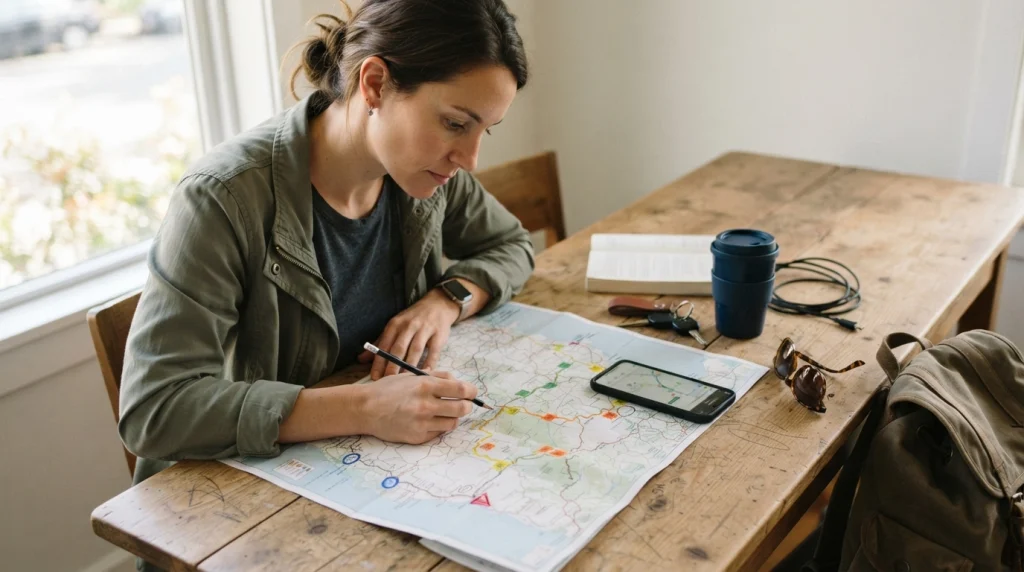
Plan the route from the largest decisions to the smallest. Start with your endpoints and total number of days, then divide the journey into driving stages before adding restaurants, viewpoints, or small detours.
1. Mark your starting point and final destination
Put the non-negotiable locations on your map first. These may include home, an airport, a friend’s house, a conference, or your main vacation destination.
Don’t add optional stops yet. You first need to understand the simplest version of the journey.
2. Check the direct route
Look at the basic driving distance and estimated travel time. Treat the estimated time as a starting point rather than the number of hours your entire day will take.
A five-hour drive can become a much longer day after fuel, food, traffic, restrooms, photography stops, and roadworks.
3. Divide the route into comfortable driving days
Choose daily segments based on how you normally feel behind the wheel. Someone comfortable driving six hours may plan differently from someone who becomes tired after three.
- Mark a preferred overnight area for each day.
- Check how far apart towns and services are.
- Identify stretches where fuel availability may be limited.
- Notice mountain, desert, rural, or border sections that could slow you down.
- Leave one or two shorter days in a longer itinerary.
4. Add high-priority stops
Once the driving framework feels comfortable, add the places that matter most. Limit your must-see stops so your route still works when something takes longer than expected.
I like separating stops into three groups: must do, would like to do, and only if convenient. That makes it easier to drop something without feeling that the day failed.
5. Check the route in both directions
If the road trip is a loop, compare clockwise and counterclockwise versions. One direction may give you better accommodation timing or shorter final driving days.
For international trips, confirm local driving rules before committing to a route. The U.S. Department of State’s international travel planning guidance is one useful starting point for checking advisories, documentation, local laws, and travel preparation.
6. Save a backup route
Your alternative doesn’t need to be another complete vacation. It can simply be a safer main road that bypasses a remote scenic section or an extra overnight town if you stop early.
- One alternative road around remote sections
- One backup overnight town
- One secondary fuel stop
- One saved accommodation option
- One plan for bad weather or road closure
Section Takeaway: Build the skeleton of the trip before decorating it with attractions. A strong route still works after delays, skipped stops, or an earlier-than-planned overnight stay.
How Far Should You Drive Each Day on a Solo Road Trip?
There isn’t one ideal daily distance for every woman. Your driving experience, road type, daylight, weather, traffic, and planned activities matter more than chasing a mileage target.
For planning, I think in driving hours rather than miles. Two hundred miles on a fast highway and 200 miles on winding mountain roads can create completely different days.
| Planning style | Suggested driving window | Best fit | What the day can include |
|---|---|---|---|
| Relaxed | About 2–4 hours | First solo road trips or scenic routes | Long meals, sightseeing, several stops |
| Balanced | About 4–6 hours | Typical multi-day road trips | A main attraction plus breaks |
| Driving-focused | About 6–8 hours | Experienced drivers covering distance | Mostly driving, meals, fuel, and rest stops |
Those ranges are planning examples, not safety limits. If you feel tired, uncomfortable, distracted, or sleepy, stop rather than trying to reach a number on an itinerary.
Count the whole day, not just the steering time
Suppose your navigation app estimates five hours of driving. Add breakfast, fuel, two rest breaks, lunch, parking, check-in, and any sightseeing before deciding whether the day is realistic.
- Driving: 5 hours
- Two short breaks: 30–40 minutes total
- Lunch: 45–60 minutes
- Fuel and small delays: 20–30 minutes
- One attraction: 60–90 minutes
A five-hour driving estimate can therefore occupy most of an eight-hour travel day. This is why dense itineraries often feel harder on the road than they did on the planning screen.
Use daylight as part of your route
If you’re uneasy about arriving alone after dark, work backward from your preferred arrival time. Choose the overnight stop first, then calculate when you should leave.
That small change can make the itinerary feel much calmer. It also gives you a clear point at which to skip an optional stop.
Section Takeaway: Plan daily distance around your comfortable driving time and total travel day. Reaching the next hotel safely matters more than completing every planned stop.
How Do You Choose Safe and Useful Road Trip Stops?
Choose stops for function as well as sightseeing. A strong solo road trip itinerary includes places where you can reliably rest, eat, refuel, use a restroom, and sleep.
Plan fuel before you need it
Don’t wait for a nearly empty tank before searching for fuel in an unfamiliar region. Mark likely fuel stops before long rural, mountain, desert, or nighttime sections.
I would rather stop slightly early at a busy station than depend on the final fuel option shown on a map.
Choose overnight areas before individual hotels
First decide which town or neighborhood makes sense for your route. Then compare accommodation inside that area.
- Recent guest reviews
- Well-lit parking or secure parking arrangements
- Reception or check-in procedures
- Distance from the next day’s route
- Nearby food and fuel
- Cancellation terms
Don’t post your exact room number or live accommodation details publicly. Official travel guidance for women also advises travelers to be careful about revealing where they are staying.
Build planned rest stops into boring sections
Long highway stretches can become mentally tiring even when navigation is simple. Save a few populated rest points so you aren’t making every decision while already fatigued.
Your stop does not need to be a major attraction. A supermarket, visitor center, café, busy service area, or town center can provide a useful reset.
Give important attractions a time budget
Parking, walking, tickets, queues, and photos can turn a quick stop into two hours. Give priority attractions a realistic time window before adding the next driving segment.
- Quick viewpoint: roughly 20–40 minutes
- Meal stop: roughly 45–75 minutes
- Short walk or attraction: roughly 1–2 hours
- Major sightseeing stop: consider making it the day’s main activity
These are itinerary planning estimates, not fixed rules. Adjust them to the destination and your pace.
Section Takeaway: Every major route segment should connect useful services as well as attractions. Plan fuel, meals, rest, and accommodation before adding optional detours.
How Do You Build Safety and Backup Plans Into the Route?
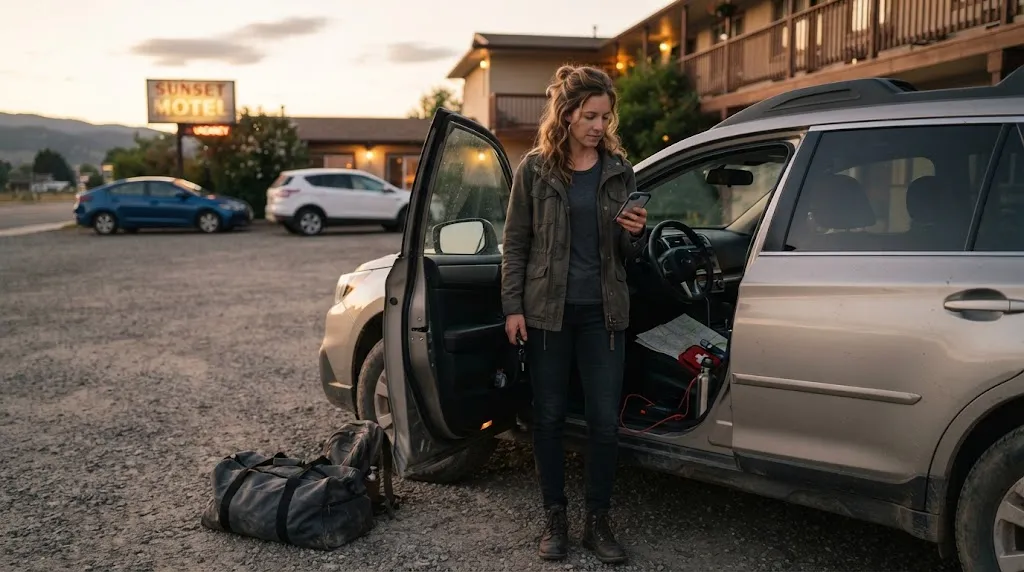
A solo female road trip safety plan should answer three questions: Where am I expected to be, who knows my plan, and what will I do if the original route stops working? Keep those answers simple enough to use under stress.
Share the broad itinerary with someone you trust
Give one person your main route, overnight towns, accommodation details, and approximate check-in expectations. Agree on what they should do if they cannot reach you after a planned check-in.
This doesn’t require sending updates every hour. A morning departure message and an evening arrival message may be enough for many trips.
Keep essential information available offline
Phone service can disappear at inconvenient moments. Save the information you would need to continue safely without a data connection.
- Offline map of the driving area
- Accommodation address and phone number
- Emergency contacts
- Roadside assistance information
- Insurance details
- Vehicle rental information, if applicable
- Passport or identification backup information where appropriate
Check the vehicle before the trip
A road trip route is only useful if the vehicle is ready for it. Check the basics before leaving and understand how to use the equipment already inside the car.
- Tire condition and pressure
- Fuel or charging plan
- Lights and signals
- Windshield visibility
- Fluids appropriate to the vehicle
- Spare tire or puncture kit
- Roadside assistance contact
Plan for health needs too
For international travel, the CDC recommends checking destination-specific health information before departure. Its pre-travel guidance also recommends planning ahead for health needs and unexpected problems.
Pro tip: Before an international road trip, check current government travel advisories and destination-specific CDC guidance rather than relying on an old blog post or saved screenshot.
Have a rule for abandoning the plan
Decide in advance what would make you stop, reroute, or book the nearest reasonable room. That removes pressure to prove that you can finish a difficult driving day.
- You become sleepy or unwell.
- Weather makes the planned road uncomfortable.
- A road closure adds substantial extra driving.
- Your vehicle develops a warning or mechanical problem.
- You reach an isolated section much later than planned.
- A stop or accommodation feels uncomfortable when you arrive.
A route is a plan, not a promise. Changing it is part of independent travel.
Section Takeaway: Good solo female travel safety is built into the itinerary before departure. Share the route, save essential information offline, and give yourself permission to change plans early.
How Do You Use Maps Without Overplanning the Trip?
Use mapping tools to understand the route, not to schedule every minute. Keep your main driving stages firm while leaving optional attractions flexible.
Use one master route
Create one main version containing your overnight locations and essential stops. Avoid keeping several conflicting versions across notes, screenshots, and different apps.
Then maintain a short list of optional detours. You can choose from them when you know how the day is going.
Compare route options before departure
The fastest route isn’t automatically the one you will prefer. Compare major roads, tolls, border crossings, ferry requirements, mountain sections, fuel availability, and the towns available for overnight stays.
For trips involving several transport modes, Rome2Rio can also help compare routes involving driving, trains, buses, ferries, and other transport options.
Download offline navigation
Save the essential map area before departure if your mapping app supports offline navigation. Test that the map opens while your phone is disconnected from mobile data.
- Main road trip route
- Overnight destinations
- Fuel stops
- Backup towns
- Important attractions
- Hospitals or emergency services where appropriate
Leave some empty space in the itinerary
My preferred route has one or two things I can remove without affecting the trip. That flexibility becomes valuable when breakfast runs late, traffic slows down, or a place deserves more time.
For a seven-day trip, I also prefer not to make every day equally demanding. A short driving day in the middle can make the rest of the route feel much easier.
Review the route again the night before each driving day
Check weather, road conditions, fuel availability, accommodation details, and your estimated arrival time. This takes only a few minutes but keeps an old itinerary from overriding current conditions.
As of 2026, route-planning tools make it easy to create detailed itineraries. They still cannot replace checking current conditions and making a judgment based on what is happening around you.
Section Takeaway: Keep the route structured but not rigid. Your overnight stops and essential logistics need clarity, while optional sightseeing should remain easy to change.
Frequently Asked Questions About Planning a Solo Road Trip Route
Is a solo road trip a good idea for a first-time solo traveler?
It can be, especially if you already feel comfortable driving alone. Start with a short route, familiar road conditions, reliable accommodation, and populated stops instead of making your first trip an ambitious cross-country drive.
Should I book every hotel before a solo road trip?
You don’t always need to book every night, but first-time solo travelers may appreciate having key overnight stops confirmed. On flexible trips, at least research backup accommodation so you aren’t starting from zero late in the day.
Is it better to take highways or scenic roads when traveling alone?
Neither is automatically better. Highways may offer simpler navigation and more services, while scenic roads may be slower or more isolated, so compare road conditions, daylight, fuel access, weather, and your driving comfort.
How often should I tell someone where I am during a solo road trip?
Choose a check-in routine that is simple enough to maintain. Many travelers can use planned departure and arrival updates, while remote routes may justify sharing more detailed location information with a trusted contact.
What should I do if I get tired before reaching my planned hotel?
Stop driving and reassess the route. Find a safe place to rest or arrange suitable nearby accommodation rather than pushing through fatigue simply because the original itinerary says you should arrive that night.
How much should I plan before leaving?
Plan the parts that affect safety and logistics: roads, overnight locations, fuel, essential bookings, vehicle needs, and backup options. Leave minor attractions and meal choices flexible unless they require advance reservations.
What is the most important part of a solo female road trip route?
The most important part is creating a route you can change without creating a crisis. Comfortable driving days, sensible overnight stops, reliable services, and backup options matter more than fitting the maximum number of destinations into the trip.
Final takeaway: Plan a solo road trip route around your energy, not around the maximum distance your map says you can cover. Set realistic driving days, identify useful stops, check current conditions, and always leave yourself another option.
A successful solo road trip doesn’t require a perfect itinerary. It requires a route that helps you stay informed, rested, flexible, and confident enough to change direction when the situation calls for it.