How Can a Solo Female Traveler Find Destinations With Female-Friendly Accommodation?
Quick Answer
A solo female traveler can find destinations with female-friendly accommodation by researching the neighborhood before the hotel, reading recent reviews from women traveling alone, and checking practical safety features such as staffed reception, secure entry, reliable transport, and private or female-only room options. I also compare these findings with official lodging safety guidance before making a final booking.
My Six-Point Accommodation Test
- Start with location: Choose neighborhoods near useful transport, restaurants, shops, and places you expect to visit.
- Read recent reviews: Focus on comments about nighttime surroundings, staff behavior, locks, noise, check-in, and solo stays.
- Check secure access: Look for controlled entrances, working room locks, lockers where relevant, and clearly described reception procedures.
- Compare room types: Consider hotels, private hostel rooms, small guesthouses, and female-only dorms based on your comfort level.
- Plan your arrival: Know exactly how you will reach the property, especially after a flight, train, or bus journey.
- Keep a backup: Save one alternative property in case the first place feels different from its listing.
Finding female-friendly accommodation is one of the first things I research when planning solo female travel. A beautiful destination becomes much easier when my accommodation feels practical, comfortable, and straightforward to reach.
I don’t search for a magical “safe hotel” label. Instead, I look for evidence that the destination and property will work well for a woman traveling independently.
In This Guide
- What Does Female-Friendly Accommodation Mean?
- How Do I Find Destinations With Better Accommodation Options?
- What Should I Check Before Booking Accommodation?
- Which Accommodation Type Works Best for Women Traveling Alone?
- How Can Reviews Reveal Whether a Property Is Female-Friendly?
- How Should I Plan My Arrival and First Night?
- Frequently Asked Questions
What Does Female-Friendly Accommodation Mean?
Female-friendly accommodation is lodging that makes it reasonably easy for a woman traveling alone to manage privacy, access, transportation, communication, and personal security.
It doesn’t necessarily mean women-only accommodation. A regular hotel, guesthouse, apartment, or hostel can work well if its location and operating practices suit solo travelers.
Female-friendly does not mean risk-free
No hotel or destination can guarantee complete safety. What I want is a property that removes avoidable problems rather than creating new ones.
For example, I prefer accommodation where I don’t need a long isolated walk after leaving public transport. I also want clear check-in instructions before I arrive.
- Practical location: Nearby transport, food, pharmacies, and everyday services.
- Clear access: Straightforward entrance and check-in procedures.
- Privacy: Secure doors, curtains, and suitable room arrangements.
- Responsive staff: Someone I can contact if a room or access problem appears.
- Useful reviews: Recent feedback from travelers with similar concerns.
Think about comfort as well as security
A property can have strong security and still be a poor fit. A noisy party hostel, for example, might leave you exhausted even if its entrance is tightly controlled.
Your ideal accommodation should match your social comfort, sleep needs, budget, and travel style.
For my own trips, I sometimes choose a private hostel room because I can join communal spaces when I want company. I still have a private place to recharge afterward.
Section Takeaway: Female-friendly accommodation is about the complete experience—location, access, privacy, transportation, staff support, and your personal comfort level.
How Do I Find Destinations With Better Accommodation Options?
I begin with destinations that offer several realistic places to stay in neighborhoods I would genuinely use. More choice gives me room to compare location, price, reviews, and room types.
I don’t pick a destination first and assume I will solve accommodation later. Accommodation is part of my destination test.
Search neighborhoods before individual hotels
Open a map and identify two or three areas commonly used by visitors. Then check how those areas connect with transportation and the activities on your itinerary.
This prevents a common mistake: finding an attractive room at a low price but discovering that it sits far from everything you need.
- Check the distance to train or metro stations.
- Look for restaurants and convenience stores nearby.
- Check your likely airport or station transfer.
- Research how transportation operates after dark.
- Read recent comments about the immediate neighborhood.
Look for variety in accommodation types
Destinations with hotels, hostels, guesthouses, serviced apartments, and private hostel rooms give you more flexibility. I especially appreciate having alternatives within the same neighborhood.
If my original reservation doesn’t work, changing properties becomes much simpler.
Check official destination guidance
As of 2026, I still treat current official information as an essential planning layer. Conditions can change faster than old travel articles or social media recommendations.
The U.S. State Department maintains destination guidance and a dedicated resource for women travelers, including advice about local customs, transportation, accommodation, and privacy.
Pro tip: Before booking an international trip, check your government’s current destination advisory and local official travel information rather than relying on a single blog or review platform.
Section Takeaway: Find the neighborhood first, then compare properties. A destination with several suitable accommodation options gives you more control if plans change.
What Should I Check Before Booking Accommodation?

Before paying, I run every property through the same practical checklist. This takes about 15 minutes once you know what to look for.
The goal isn’t to investigate every possible problem. It’s to remove obvious uncertainty before your arrival day.
Check location and transportation
I look at the complete journey from my airport, station, or bus terminal to the front door. A hotel isn’t conveniently located just because the booking site calls it “central.”
- Arrival route: Can I explain the route in one or two simple steps?
- Public transport: Is a useful stop within a comfortable walking distance?
- Backup transport: Are licensed taxis or reputable ride services available?
- Evening access: Will I need a long walk if I return after dinner?
- Daily convenience: Are food and basic services nearby?
Check property access
Look for clear descriptions of reception hours, building access, room locks, and late check-in procedures. Vague information isn’t automatically bad, but it gives me a reason to ask questions.
The U.S. State Department’s lodging guidance recommends researching lodging carefully before travel and considering measures such as staffed lobby service, gates, or security personnel. It also advises travelers to confirm that room doors and windows lock properly after arrival.
Check your room configuration
A private room may suit you better if sleep and privacy matter most. A female-only dorm can work when budget and social interaction are more important.
For shared rooms, I check whether secure lockers are available. I also confirm whether I need to bring my own lock.
Check cancellation flexibility
I often pay a little more for a flexible first-night booking in an unfamiliar city. That flexibility gives me an easier exit if the property doesn’t match its description.
You don’t need luxury. You need options.
Section Takeaway: Check the door-to-door arrival route, property access, room setup, recent feedback, and cancellation terms before you commit.
Which Accommodation Type Works Best for Women Traveling Alone?
There isn’t one accommodation type that is best for every solo female traveler. Your ideal choice depends on privacy, budget, social comfort, support, and destination.
Here’s how I compare the main options.
| Accommodation Type | Privacy | Social Contact | Best Fit | Check Carefully |
|---|---|---|---|---|
| Hotel | High | Low | Travelers wanting privacy and straightforward service | Reception hours, location, room access |
| Private hostel room | High | Moderate to high | Travelers wanting privacy plus social spaces | Noise, bathroom arrangement, room locks |
| Female-only hostel dorm | Low to moderate | High | Budget and social travelers | Locker size, dorm size, curtains, bathroom setup |
| Guesthouse | Usually high | Low to moderate | Travelers wanting a smaller atmosphere | Staff availability and late check-in |
| Apartment | High | Low | Longer stays and travelers wanting kitchen facilities | Building access, host support, exact location |
Hotels work well when you want simplicity
I like hotels when arriving late, carrying more luggage, or visiting a city where I expect busy days. A staffed front desk can make small problems easier to solve.
Female-only dorms can reduce one source of uncertainty
Some women feel more comfortable sharing sleeping space only with women. These rooms can also make meeting other female travelers easier.
Still, the “female-only” label doesn’t replace normal research. Check lockers, door security, cleanliness, staff availability, and location too.
A private hostel room gives you both options
This is one of my favorite arrangements when traveling alone. I can join a walking tour or sit in the lounge, then close my own door at night.
Section Takeaway: Choose accommodation based on how you want to sleep, socialize, arrive, and handle problems—not on what solo travelers are supposedly expected to book.
How Can Reviews Reveal Whether a Property Is Female-Friendly?
Reviews are most useful when you search them for specific patterns rather than looking only at the average score. A 9/10 rating cannot answer every question that matters to a solo woman.
I focus on recent reviews first because staffing, neighborhoods, and property management can change.
Search for comments from solo travelers
Many booking platforms let you filter reviews by traveler type. If not, search review text for words connected with your concerns.
- solo
- woman or female
- night
- street
- station
- reception
- lock
- locker
- taxi
- noise
Look for repeated patterns
One unhappy review can reflect a one-off experience. Five recent reviews mentioning the same broken lock or difficult nighttime access deserve more attention.
I treat repeated specific comments as more useful than vague statements such as “bad area” or “felt unsafe.”
Red flags I investigate before booking
- Unexpected location complaints: Guests repeatedly say the map or listing creates a misleading impression.
- Unclear late check-in: Travelers report being unable to enter the property.
- Broken security features: Recent reviews mention faulty door locks or lockers.
- Unresponsive management: Several guests describe serious problems being ignored.
- Isolated approach: Multiple solo travelers mention uncomfortable walks from transportation after dark.
A negative comment doesn’t always make me reject a property. It tells me what question to investigate next.
Section Takeaway: Read recent reviews for repeated, specific patterns. The most useful reviews describe access, staff, transport, room security, and the immediate neighborhood.
How Should I Plan My Arrival and First Night?
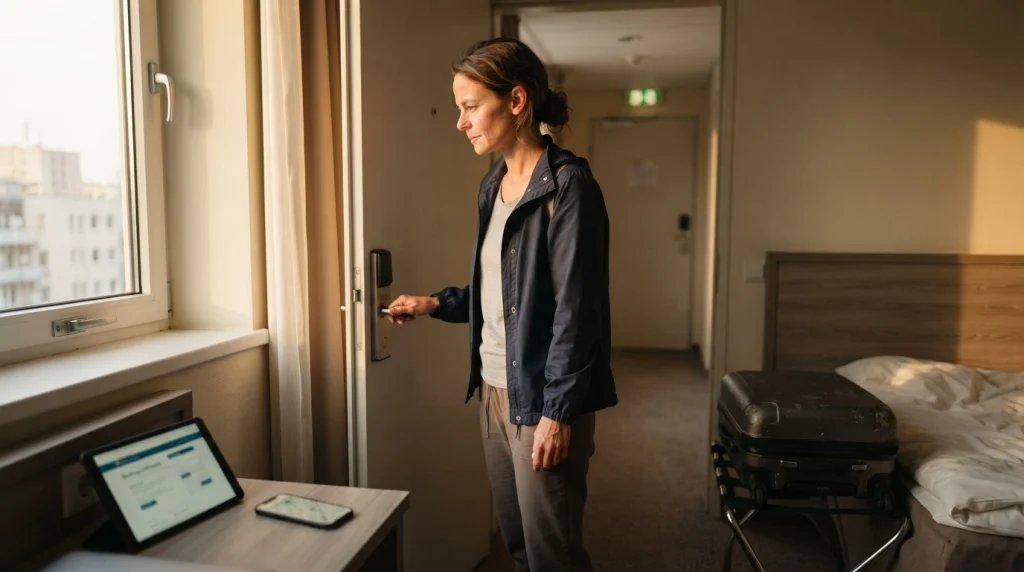
Your accommodation choice is only half the plan. You also need a clear way to reach it while tired, carrying luggage, or dealing with a delayed journey.
This is where I try to make my first solo evening deliberately boring. Simple is good.
Choose a manageable arrival time when possible
For a new destination, I prefer arriving with enough daylight or normal evening activity left to understand my surroundings. It gives me more options if transportation or check-in goes wrong.
Of course, flight schedules don’t always cooperate. When arriving late, I simplify the transfer rather than improvising after landing.
Save essential information offline
- The property’s full address.
- A screenshot of the booking confirmation.
- Check-in instructions.
- A map showing the final walking route.
- The property’s phone or messaging contact.
- One backup accommodation nearby.
Check the room before unpacking
I spend the first few minutes checking practical things instead of immediately opening my suitcase. That includes the room door, windows, curtains, and any connecting door.
I also locate the nearest emergency exit. The State Department’s lodging guidance recommends identifying emergency routes and checking that doors and windows lock properly.
Keep your accommodation details private
I don’t casually tell strangers my room number. I also avoid announcing exactly where I’m staying during new social encounters.
Official women traveler guidance similarly advises travelers not to tell strangers where they are staying.
Pro tip: Save local emergency information and your government’s embassy or consular contacts before an international trip. Rules and emergency procedures differ by destination.
Section Takeaway: Plan the complete journey to the property before departure, save details offline, check your room on arrival, and maintain reasonable privacy about where you’re staying.
Frequently Asked Questions
What makes a destination female-friendly for accommodation?
A destination is easier for solo women when it offers several well-reviewed accommodation types in practical neighborhoods, dependable transport, clear arrival options, and enough competition to switch properties if necessary. Current local conditions still need separate research.
Are female-only hostels safer for solo female travelers?
A female-only dorm can increase comfort for women who prefer sharing sleeping space only with other women. However, you should still check building access, lockers, room locks, reception, recent reviews, transportation, and the surrounding neighborhood.
Should I choose a hotel or hostel for my first solo trip?
Choose a hotel if privacy, quiet, and predictable service matter most. Consider a private hostel room if you want privacy plus social spaces, or a female-only dorm if budget and meeting travelers are priorities.
How far should my accommodation be from public transport?
There is no universal perfect distance. I care more about the complete walking route than the number of meters. A slightly longer route on active, straightforward streets may be easier than a shorter route involving isolated paths or complicated transfers.
How many reviews should I read before booking?
There is no required number. I usually read enough recent reviews to identify patterns, especially comments from solo travelers about arrival, staff, noise, security, transportation, and nighttime surroundings.
Should I book my first night before arriving?
For solo travel, especially in an unfamiliar destination, I strongly prefer having the first night arranged. Knowing exactly where I’m going reduces decisions during the part of the journey when I’m often most tired.
What should I do if my accommodation feels wrong after arrival?
Address specific problems with reception or management when appropriate. If you remain uncomfortable, move to your backup accommodation when you can do so safely and practically rather than staying simply because you’ve already paid.
Final Takeaway
Finding destinations with female-friendly accommodation isn’t about searching for one official label. It’s about building a picture from location, transportation, room options, current reviews, property access, official travel guidance, and your own comfort level.
I choose the neighborhood first, inspect the arrival route, compare several properties, and keep one backup. That small amount of preparation makes the destination feel much easier once I arrive.
Start with two or three destinations you’re excited about. Run each through the same accommodation test, and let the practical details help you narrow the list.