How Can a Solo Female Traveler Choose Between a City and a Small Town?
Quick Answer
A solo female traveler should choose between a city and a small town by comparing transportation, accommodation, safety logistics, social opportunities, pace, budget, and backup options. Cities usually make independent travel easier when you want frequent transport and plenty of alternatives, while small towns can suit travelers who prefer a slower pace and simpler surroundings. Before booking, review official guidance for women travelers.
The main differences to compare
- Transportation: Choose the place where you can move around confidently without complicated transfers or unwanted driving.
- Backup options: Cities usually offer more hotels, restaurants, pharmacies, transport routes, and activities if plans change.
- Pace: Small towns may feel calmer, while busy cities can provide more structure and activity.
- Social opportunities: Cities often provide more tours, hostels, classes, events, and places to meet other travelers.
- Independence: A small town works best when opening hours, transport schedules, and distances will not restrict your plans.
- Comfort: Pick the environment that reduces your personal stress rather than choosing based on population size alone.
My simple rule
- Choose the destination where everyday logistics feel easiest to manage alone.
If you’re wondering how a solo female traveler can choose between a city and a small town, population size shouldn’t be your first test. I would start with a much more practical question: which place makes your daily decisions easier?
A beautiful village can become stressful when the last bus leaves at 6 p.m. A busy city can feel surprisingly manageable when your hotel, train station, restaurants, and activities are all easy to reach.
In This Guide
- What Are the Main Differences Between Solo Travel in a City and a Small Town?
- Which Is Easier for Transportation When You’re Traveling Alone?
- Is a City or Small Town Safer for a Solo Female Traveler?
- Where Is It Easier to Meet People and Avoid Feeling Lonely?
- How Do Accommodation and Budget Change the Decision?
- How Can You Decide Which Destination Type Fits You?
- Frequently Asked Questions
What Are the Main Differences Between Solo Travel in a City and a Small Town?
The biggest difference isn’t crowds. It is how many practical choices you have when something doesn’t go according to plan.
Solo female travel means traveling without a companion while independently managing your transportation, accommodation, money, activities, safety decisions, and schedule.
A city often gives you several solutions to the same problem. You may have trains, buses, licensed taxis, rideshare services, and walkable neighborhoods available at the same time.
- More accommodation: You may be able to compare hotels, hostels, guesthouses, and apartments across several neighborhoods.
- More food choices: Finding an early breakfast or late dinner is often easier.
- More activities: Museums, walking tours, classes, cafés, shopping areas, and events create ready-made structure.
- More alternatives: Bad weather or a canceled activity doesn’t have to ruin the day.
- More stimulation: Noise, crowds, traffic, navigation, and busy stations may also feel tiring.
A small town changes the equation. You may have fewer decisions, but the available choices can matter more.
The only train of the afternoon might become important. So might the distance between your accommodation and the center of town.
- Slower pace: You may find fewer crowds and less pressure to keep moving.
- Compact center: Some towns make walking between restaurants, shops, and attractions easy.
- Limited schedules: Buses, restaurants, attractions, and shops may operate for shorter hours.
- Fewer backups: Changing accommodation or transportation at short notice may be harder.
- More quiet: This can feel peaceful or isolating depending on your travel style.
| Factor | City | Small Town |
|---|---|---|
| Public transport | Often frequent and varied | May be limited or timetable-dependent |
| Accommodation choice | Usually wider | Usually smaller |
| Social opportunities | Tours, hostels, events, classes | Often fewer organized options |
| Noise and crowds | Can be significant | Often lower |
| Backup plans | Usually plentiful | May require advance planning |
| Car dependence | Often avoidable | Can be higher |
| Typical pace | Flexible but potentially intense | Slower and quieter |
I don’t treat either column as automatically better. I look for the environment where the disadvantages are easiest for me to manage.
Section Takeaway: City versus small town is mainly a logistics decision. The better fit is the place where transportation, accommodation, activities, and backup plans match how you like to travel.
Which Is Easier for Transportation When You’re Traveling Alone?
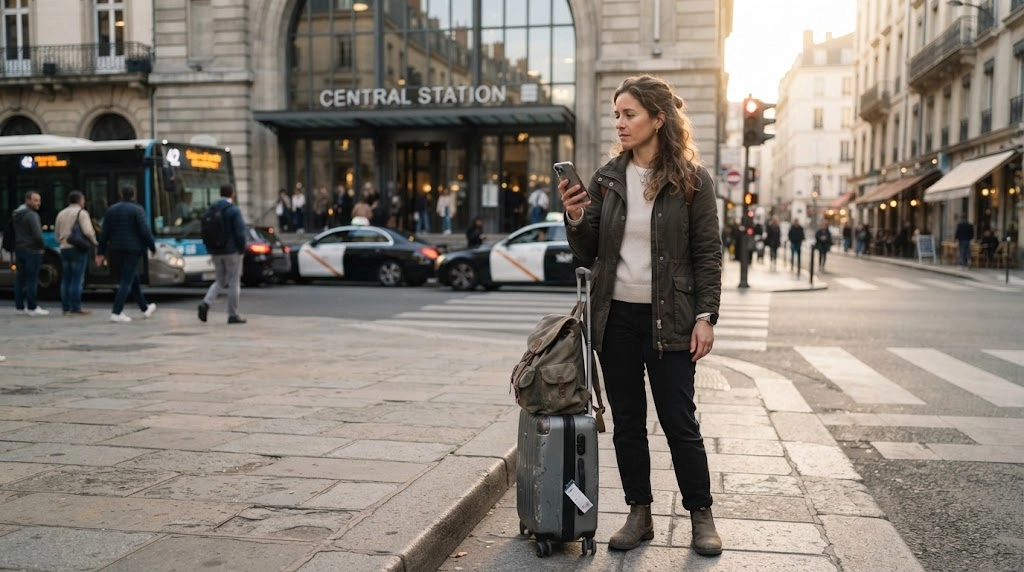
A well-connected city is usually easier if you don’t want to drive. A small town can still work beautifully when its center is walkable and your arrival route is simple.
I check transportation before attractions. An amazing itinerary isn’t useful if reaching every stop becomes an exhausting project.
Check your arrival route first
Your first journey should be the route from the airport, railway station, or bus terminal to your accommodation. Research it door to door.
- Identify the exact airport or station you’ll use.
- Check the official public transportation option.
- Find the last useful departure time.
- Check a reputable taxi or rideshare alternative.
- Estimate the full door-to-door journey.
- Save the accommodation address offline.
A city hotel that requires one simple train ride may feel easier than a countryside guesthouse requiring a train, bus, and taxi. The reverse can also be true when a small-town hotel sits beside the station.
Ask what happens after dinner
Daytime transportation doesn’t tell the whole story. Check what happens after restaurants, shows, tours, or evening activities finish.
- When does public transport stop?
- Are taxis or reputable rideshares available?
- Is your accommodation within a comfortable walking distance?
- Are streets well used during the evening?
- Could you leave an activity early without getting stranded?
The U.S. State Department advises women travelers to research local transportation and use reputable transport providers. You can review its current guidance at Travel.State.gov.
*Pro tip: Transportation conditions change. Check official local transit operators and current government travel advice shortly before departure.*
Decide whether renting a car adds freedom or stress
A rental car can make a rural trip much easier. It can also introduce unfamiliar roads, parking, fuel, navigation, tolls, and driving rules.
- Consider a car: Attractions are spread out and public transportation is weak.
- Skip the car: Trains, buses, and walking already cover your itinerary.
- Check parking: Accommodation parking should be clear before booking.
- Protect daylight: Avoid designing a first solo itinerary that depends on unfamiliar late-night driving.
Sites such as Rome2Rio can help you understand possible connections. Confirm important schedules with the actual transport operator before traveling.
Section Takeaway: Choose the destination where you understand both your normal transport plan and your backup plan. Independence matters more than whether the place is officially classified as a city or town.
Is a City or Small Town Safer for a Solo Female Traveler?
Neither is automatically safer. Safety varies by destination, neighborhood, time of day, transportation system, current conditions, and your specific itinerary.
Population size can create misleading assumptions. A quiet-looking place isn’t automatically low-risk, and a crowded city isn’t automatically unsuitable for women traveling alone.
Research neighborhoods, not just destinations
A large city can contain areas with completely different transportation, lighting, crowds, hotel quality, and late-night activity. Where you sleep may matter more than the city’s overall reputation.
- Look for recent accommodation reviews discussing location.
- Check how far the property is from public transportation.
- Map your likely evening routes.
- Research local taxi and rideshare practices.
- Locate nearby pharmacies and medical facilities.
- Check current government travel advice.
Small towns require the same level of research. Fewer people and less traffic can feel comfortable, but isolation can reduce your options when you need transportation or assistance.
Compare access to help
I like knowing what I would do if my phone died, accommodation canceled, or transport failed. This isn’t pessimistic planning.
It’s a way to reduce pressure when I’m making decisions alone.
- Accommodation: Are other suitable places available nearby?
- Transport: Is there more than one realistic way to leave?
- Communication: Will you have reliable mobile data or Wi-Fi?
- Healthcare: Is appropriate medical help reasonably accessible?
- Emergency support: Do you know the local emergency number?
For international travel, review your destination’s current official advisory rather than relying only on old forum discussions. Health-related requirements can also be checked through the CDC Travelers’ Health section when relevant.
*Pro tip: Save important phone numbers, your accommodation address, insurance information, and essential reservations offline before leaving.*
Think about how the destination feels after dark
You don’t need to build your trip around nightlife. You do need to think about evenings because dinner, transport delays, and seasonal daylight can keep you outside later than expected.
- Can you eat near your accommodation?
- Can you return using a straightforward route?
- Are reputable transportation options still operating?
- Will you need to walk through an isolated area?
- Could you change plans without creating another problem?
Section Takeaway: Don’t compare safety using city size alone. Compare your exact neighborhood, transportation plan, evening routine, communication options, and access to help.
Where Is It Easier to Meet People and Avoid Feeling Lonely?
Cities usually offer more structured ways to meet people. Small towns may offer slower, more natural interactions, but organized social options can be limited.
This matters more than many first-time solo travelers expect. You may love independence during the day and still want company for a walking tour or dinner.
Cities create optional social structure
A large destination can make socializing easier without forcing you to depend on strangers. You can choose one organized activity and keep the rest of your day independent.
- Walking tours
- Cooking classes
- Language exchanges
- Hostel events
- Museum tours
- Food tours
- Meetup-style activities
You can also leave whenever you’ve had enough. That flexibility works well for shy or introverted travelers.
Small towns can feel personal but quiet
In a small destination, you may return to the same café or see familiar faces during a two-night stay. Those repeated interactions can make a place feel welcoming.
The trade-off is choice. If you dislike the only evening activity, there may not be another one ten minutes away.
Choose according to your social battery
- You like constant options: A city may suit you.
- You enjoy quiet evenings: A small town may feel refreshing.
- You want easy group activities: Look for a destination with established tours.
- You tire quickly in crowds: Choose a compact city, quieter neighborhood, or smaller destination.
- You fear loneliness: Make sure there are at least two optional social activities during your stay.
Travel publications such as Lonely Planet can help you understand what kinds of activities and travel infrastructure a destination offers. Check current local sources for schedules and availability.
Section Takeaway: Cities usually offer more optional social structure, while small towns may provide more quiet. Choose based on how much interaction you want available, not how social you think a solo traveler should be.
How Do Accommodation and Budget Change the Decision?
Don’t compare room prices alone. Compare the total cost of staying in each destination.
A cheaper small-town room can become expensive if you need taxis every day. A more expensive city hotel may reduce transport costs when everything is nearby.
Calculate the real daily cost
- Accommodation per night
- Airport or station transfer
- Daily local transportation
- Meals and groceries
- Activities and admission fees
- Taxi or rideshare backup
- Parking and fuel if driving
- Mobile data
- Travel insurance
I also budget for one inconvenient moment. That might mean a taxi when I’m tired or a simple meal close to my hotel instead of searching for the cheapest option.
Location can be worth paying for
A central room isn’t automatically the best room. Still, convenient accommodation can remove several daily problems at once.
- Shorter walks with luggage
- Easy access to public transportation
- Nearby food options
- More activity around the property
- Less dependence on late-night taxis
In a small town, I would check the map carefully before choosing a scenic property outside the center. A beautiful countryside stay can be inconvenient without a car.
Choose accommodation for your energy level
Your room is also where you’ll recover. Busy cities can make quiet accommodation more valuable.
A hostel may help you meet people, while a private hotel room may give you better rest. Neither choice says anything about how adventurous you are.
- Social hostel: Useful when meeting people matters.
- Private hostel room: Gives privacy with access to common areas.
- Hotel: Often easier when rest and predictable service matter.
- Guesthouse: Can fit smaller destinations well when transport is clear.
Section Takeaway: Compare total trip cost and convenience, not nightly room rates alone. The right accommodation can make either a city or small town much easier to manage solo.
How Can You Decide Which Destination Type Fits You?

Use your own priorities instead of asking whether cities or small towns are universally better. A simple checklist makes the choice much clearer.
Choose a city when these points sound like you
- You don’t want to rent a car.
- You prefer frequent public transportation.
- You want several accommodation choices.
- You enjoy museums, cafés, tours, shopping, or nightlife.
- You want easy opportunities to meet other travelers.
- You like having backup activities when weather changes.
- You feel calmer when services are nearby.
Choose a small town when these points sound like you
- You prefer a slower pace.
- You become drained by crowds.
- Your main interests are local culture, nature, food, or quiet exploration.
- You are comfortable planning around limited opening hours.
- You have reliable transportation.
- Your accommodation is conveniently located.
- You don’t need a large choice of evening activities.
Use my seven-question booking test
- Arrival: Can I reach my accommodation without a stressful chain of connections?
- Transport: Can I get around independently during the hours I plan to explore?
- Accommodation: Are there several acceptable places within my budget?
- Safety planning: Do I understand the neighborhood, transport practices, and current travel guidance?
- Activities: Is there enough to do without exhausting myself?
- Social needs: Can I meet people if I want company?
- Backup plan: What will I do if accommodation, weather, or transport changes?
If one destination answers six or seven questions easily while another creates problems at every step, the choice becomes obvious. That’s more useful than asking whether a city is inherently better.
Consider a middle option
You don’t always need to choose between a giant metropolis and a tiny village. A compact medium-sized city can combine useful transportation with a calmer atmosphere.
Another option is a city-and-town itinerary. Spend several nights in a connected city, then add a smaller destination once you understand the region’s transport system.
- First 3 nights: Use the city to settle in, manage jet lag, and learn local routines.
- Next 2 nights: Visit a smaller town with a straightforward train or bus connection.
- Final night: Return near your departure airport if that reduces travel stress.
That approach can give you both experiences without making your entire trip depend on one travel style.
Section Takeaway: Choose the destination that removes the most friction from the type of trip you want. Transport, location, backup options, and personal comfort are stronger decision factors than population size.
Frequently Asked Questions
Is a city better for a first-time solo female traveler?
A well-connected city can be easier for a first solo trip because transportation, accommodation, food, and activities are often easier to replace when plans change. However, a compact small town can also work well when transport is simple, accommodation is central, and you are comfortable with fewer options.
Are small towns safer for women traveling alone?
Not automatically. Safety depends on the specific destination, neighborhood, transportation, current local conditions, and your itinerary. Research recent official travel information and practical details such as evening transport, mobile coverage, accommodation location, and access to help.
What if I don’t like crowded cities?
You don’t need to choose a major metropolis. Consider a medium-sized city, a quieter neighborhood, or a compact destination with strong public transportation. You can also travel during a quieter season and build rest periods into each day.
Do I need a rental car for a small town?
Not always. Some small towns have excellent rail links and walkable centers, while others are difficult without a vehicle. Check your accommodation, attractions, station, last bus times, taxi availability, and distances before deciding.
Which option is better if I’m worried about loneliness?
A city often provides more structured social opportunities, including walking tours, classes, hostels, and events. If you prefer a small town, choose one with organized activities or book a guided experience so you have optional social contact.
Should I combine a city and small town on one solo trip?
Yes, if transportation between them is straightforward. Starting in a well-connected city and adding a nearby small town can give you both convenience and a slower pace without making the itinerary too complicated.
How long should I stay in each place?
For a short first trip, staying in one base can reduce stress. On a longer itinerary, three nights in a city followed by two or three nights in a nearby small town can provide variety without constant hotel changes.
City or Small Town: What Should You Choose?
Choose the place where you can picture an ordinary day working smoothly. Think about arriving, finding breakfast, getting around, enjoying your plans, eating dinner, and returning to your accommodation.
If those basic moments look easy, you’re probably looking at a good solo destination.
A city may give you more transport, activities, people, and backup options. A small town may give you quiet, slower days, and a more compact experience.
Neither option is automatically the right one. The best choice is the destination that fits your confidence, budget, transportation needs, energy level, and reasons for traveling.
Before you book, compare the exact neighborhood, arrival route, accommodation, evening transport, and backup options. Those practical details will tell you far more than the words “city” or “small town.”