What Should a Woman Check When Entering a Hotel Alone for the First Time?
Quick Answer
When entering a hotel alone for the first time, check the room before unpacking. Test the door and window locks, inspect any connecting door, confirm the curtains close, locate the nearest emergency exit, and make sure the room phone and safety alarms appear functional. The U.S. State Department’s lodging safety guidance also recommends checking the room itself and reporting suspicious activity promptly.
Your first five-minute hotel check
- Scan the room: Look around before settling in, including behind curtains and other areas that are not immediately visible.
- Test every lock: Check the main door, windows, balcony access, and any connecting door.
- Protect your privacy: Make sure curtains or blinds close fully and avoid announcing your room number.
- Find your exit: Locate the nearest emergency stairwell and note an alternate route if one exists.
- Check communication: Confirm your phone is charged and that you know how to reach reception.
- Trust discomfort: If the room or location feels wrong, ask for another room or leave.
One useful rule
- Do your safety check before opening your suitcase. Changing rooms is much easier when you are still packed.
Walking into a hotel room alone for the first time can feel strangely vulnerable. You have a new room, an unfamiliar hallway, and no travel companion checking things beside you.
I handle that moment with a simple routine. I spend about five minutes checking the room first, then I unpack and relax.
As of 2026, this is still one of the easiest solo female travel safety habits to build. It does not require special gadgets or turning your trip into a security exercise.
In This Guide
- What should you check in the first five minutes?
- How should you check the doors, windows, and privacy?
- What emergency and room systems should you check?
- How do you protect your room number and valuables?
- What should you do if someone knocks or calls?
- When should you change rooms or leave the hotel?
- Frequently asked questions
What Should You Check in the First Five Minutes?
Your first check should answer one question: Can I comfortably secure this room and leave it quickly if necessary? Do this before showering, changing clothes, charging devices, or spreading belongings around.
Definition: A first-entry hotel safety check is a short inspection of your room’s access points, privacy, emergency route, communication options, and obvious hazards before you settle in.
Start with a simple room sweep
Keep your luggage together while you look around. You are not conducting a forensic search; you are making sure nothing obvious requires attention.
- Look behind the curtains.
- Check the bathroom and shower area.
- Look around the bed and furniture.
- Notice any open balcony or window.
- Check whether a connecting door is present.
- Notice anything damaged, tampered with, or unexpectedly open.
If housekeeping has simply left a cupboard door open, that is not automatically a danger sign. The purpose is awareness, not assuming every unusual detail means something is wrong.
I also avoid unpacking during this stage. If I decide I want another room, I can pick up my bag and walk straight back to reception.
Pause before getting comfortable
Stand near the entrance and listen for a few seconds. You may notice an adjoining-room door, extremely noisy hallway, construction access, or another issue you missed while entering.
If your room does not match what you booked, address it now. The same applies if you were accidentally given an accessible room you did not request and the layout affects your security or comfort.
How Should You Check the Doors, Windows, and Privacy?
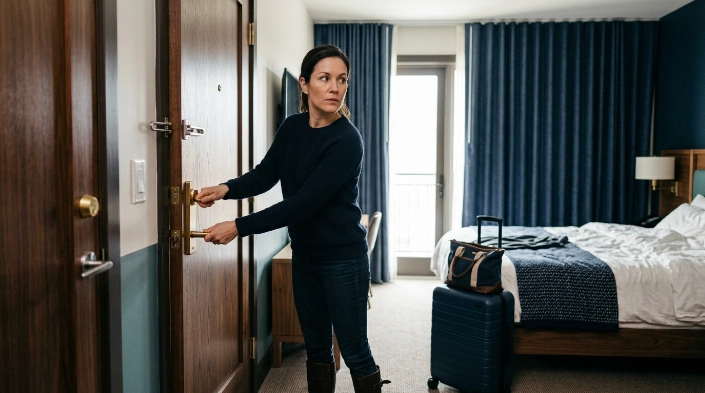
The main hotel-room door deserves the most attention. Close it fully, then test every lock that the hotel expects guests to use.
Check the main entrance
- Confirm the door closes and latches without needing to be pushed repeatedly.
- Test the deadbolt or secondary lock.
- Check the peephole, if provided, for obvious damage.
- Make sure the door does not reopen when lightly pulled.
- Keep your key card with you rather than leaving it near the entrance.
If the deadbolt does not work, contact reception. A broken security feature is a reasonable reason to request maintenance or another room.
Check windows, balconies, and connecting doors
Test any window or balcony-door lock within the room. Pay extra attention when the room is easily accessible from a roof, terrace, walkway, or ground-level outdoor space.
A connecting door should also be locked from your side. Do not assume it is secure simply because you did not request adjoining rooms.
The CDC’s overseas safety and security guidance advises travelers to lock windows and doors and, where possible, avoid rooms with certain easily accessible locations.
Make sure the room gives you privacy
Close the curtains or blinds completely and check for large gaps. At night, a bright hotel room can be much easier to see into than you realize.
I prefer solving privacy issues before changing clothes or settling down. A curtain problem that seems minor can become annoying once you are tired and ready for bed.
What Emergency and Room Systems Should You Check?
Do not wait for an alarm to figure out how to leave the floor. Find the emergency route while you are calm and fully awake.
Locate the nearest emergency exit
Look at the evacuation information normally posted near the room door. Note the nearest stairwell and whether another exit lies in the opposite direction.
- Count roughly how many doors separate your room from the stairwell.
- Notice whether the hallway turns before reaching the exit.
- Identify the stairwell door rather than relying only on elevator signs.
- Keep shoes and essential items somewhere easy to reach at night.
In an emergency, elevators may not be the appropriate exit route. Follow hotel instructions and local emergency guidance.
Check basic safety equipment and communication
Look for the room’s smoke alarm and any carbon monoxide detector the property provides. You do not need to dismantle or test hotel equipment yourself.
Instead, report missing, damaged, covered, or obviously malfunctioning equipment to staff. The State Department specifically advises travelers to check lodging safety equipment during their stay.
Also learn how to contact reception from the room. If there is a room phone, make sure it appears operational and that emergency or front-desk instructions are available.
Pro tip: Safety standards vary by destination. Check official destination guidance before international travel rather than assuming your hotel follows the same building and emergency standards as hotels at home.
How Do You Protect Your Room Number and Valuables?
Your room number is private information. There is usually no benefit in giving it to strangers or casual acquaintances you meet during the trip.
Keep your key and room details separate
If reception gives you a card sleeve displaying your room number, consider keeping the room key separate from that sleeve. That way, losing one item does not automatically reveal both the hotel and room access information together.
The State Department’s current guidance for women travelers also advises women not to tell strangers where they are staying.
Set up your essentials before going out
- Charge your phone or connect it to a power bank.
- Save the hotel’s name and address offline.
- Keep backup payment somewhere separate from your main wallet.
- Secure your passport and other important documents appropriately.
- Send your accommodation details to a trusted contact if that fits your travel plan.
A hotel safe can be useful for items you do not need during the day, but hotel security arrangements vary. Use your judgment for irreplaceable documents and valuables.
I also avoid posting my exact hotel or room location publicly while I am still staying there. Sharing photos later gives away much less useful real-time information.
What Should You Do If Someone Knocks or Calls?
You do not have to open a hotel-room door simply because someone says they work there. Verify unexpected visits first.
Verify unexpected hotel staff
If someone claims to be housekeeping, maintenance, room service, or security when you requested nothing, keep the door closed. Call reception using a verified hotel number and ask whether they sent someone.
- Use the peephole before opening the door.
- Keep the door locked while verifying the visit.
- Do not rely only on a uniform or name badge.
- Ask the person to wait while you contact reception.
- If something feels wrong, request security assistance or move to a public area when safe.
The same principle applies to phone calls asking for payment or personal details. Contact reception yourself rather than trusting an unexpected caller who claims to be hotel staff.
Meet unfamiliar people in public areas
If you meet another traveler, guide, driver, or new acquaintance, the lobby is a better first meeting place than your room. The State Department’s crime-prevention guidance for travelers similarly recommends meeting strangers in public areas.
This does not require treating every person with suspicion. It simply keeps your private sleeping space private until you decide otherwise.
When Should You Change Rooms or Leave the Hotel?
A hotel room does not need to be dramatically unsafe before you request a change. A failed lock, unexplained access issue, or staff response that leaves you uncomfortable can be enough.
| What you find | Reasonable first response | When to escalate |
|---|---|---|
| Main door or deadbolt will not secure | Request immediate repair or another room | Leave if the hotel cannot provide secure accommodation |
| Window, balcony, or connecting door will not lock | Contact reception before settling in | Change rooms if access cannot be secured |
| Unexpected person repeatedly approaches your room | Keep the door closed and contact hotel security | Contact local authorities if you believe you are in immediate danger |
| Missing or visibly damaged safety equipment | Report it and request another suitable room | Leave if serious safety concerns remain unresolved |
| Staff unexpectedly announces your room number aloud | Ask staff to protect your room information | Request a room change if your privacy may have been compromised |
| You notice suspicious activity or unexplained access | Move to a staffed public area and report it | Leave or contact authorities when necessary |
Do not let sunk cost keep you somewhere uncomfortable
Paying for a room does not mean you have to remain there no matter what happens. Keep a backup accommodation option in mind, especially during your first night in an unfamiliar destination.
If you need to leave, focus first on reaching a safe, staffed location. Refund discussions can happen afterward.
There is also a difference between ordinary first-night nerves and a specific problem. Ask yourself whether you can name the concern: a faulty lock, unwanted visitor, exposed location, suspicious access, or staff behavior.
A concrete concern deserves a concrete response. You do not need to wait until the situation becomes worse.
Frequently Asked Questions
Should a woman check under the bed when entering a hotel room alone?
A quick visual check around the bed and other concealed areas is reasonable when first entering. Current State Department lodging guidance specifically includes checking around the room, including under the bed, as part of its arrival checklist.
Should I check a hotel room for hidden cameras?
Notice obviously unusual, damaged, or strangely positioned electronics, but avoid dismantling hotel equipment based on viral online tricks. If you see something genuinely suspicious, photograph it if safe, leave the room, and contact hotel management or local authorities as appropriate.
Is a hotel room safer on a particular floor?
There is no single perfect floor for every building or destination. CDC guidance has historically recommended avoiding easily accessible ground-level locations where possible, while emergency evacuation still needs to remain practical.
Should I use a portable hotel door lock?
A portable device can provide an additional layer of reassurance where permitted, but it should not replace a functioning hotel lock. Never use a device that could prevent emergency access or violate hotel rules or local fire-safety requirements.
What if hotel staff says my room number aloud?
Ask them politely not to repeat it and request a new room if you believe someone nearby deliberately heard the information. Good front-desk practice is to protect room details rather than unnecessarily announcing them.
What if someone knocks on my hotel door late at night?
Keep the door locked and verify the visitor through reception before opening it. If the person refuses to leave, behaves aggressively, or tries to enter, contact hotel security and local emergency services when necessary.
How long should a first hotel-room safety check take?
About five minutes is enough for a practical routine. Check access points, privacy, the emergency route, basic room systems, and your communication plan, then enjoy your stay rather than repeatedly inspecting the room.
Final takeaway: When you enter a hotel alone, check the room before you unpack. A few deliberate minutes spent on locks, privacy, emergency exits, communication, and room access can remove uncertainty without turning your trip into something stressful.
Once those basics are handled, let the hotel become what it should be: a comfortable base for your solo trip.